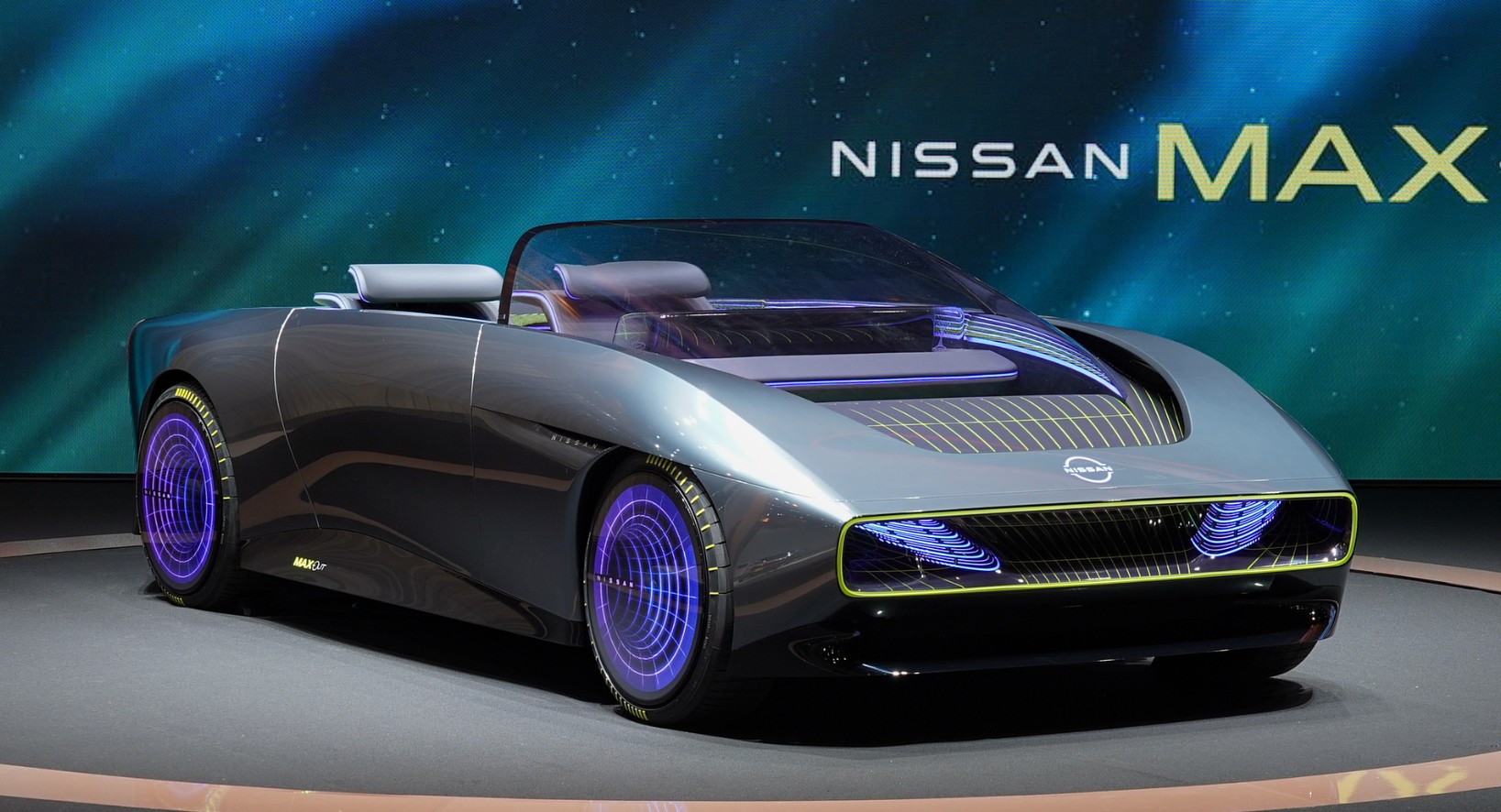
2027 Nissan Max-Out Redesign, Specs, Interior – The 2027 Nissan Max-Out remains one of the most intriguing names in Nissan’s electric-vehicle portfolio, largely because it represents something the modern EV market still lacks: a purpose-built, open-top performance car designed around electric propulsion from the beginning. Nissan introduced the Max-Out as a two-seat convertible concept, describing it as a vehicle designed around the idea of “being one with the car.” Its low-slung proportions, futuristic cabin, advanced electric architecture and highly unusual interior flexibility immediately positioned it as something very different from the company’s conventional production lineup.
There is an important distinction surrounding the 2027 Nissan Max-Out. Nissan has officially presented the Max-Out as a concept car, and the company has not announced a production-specification 2027 Max-Out with confirmed pricing, EPA range, horsepower, trim levels or a showroom launch date. Nissan’s own design gallery continues to identify Max-Out as a 2023 concept vehicle. Consequently, any discussion of a 2027 production model must be treated as a forward-looking projection rather than confirmed specifications.
That uncertainty does not make the Max-Out irrelevant. Quite the opposite: the concept offers a revealing look at how Nissan imagines an emotionally engaging electric vehicle. The original concept was engineered around lightweight construction, a very low center of gravity and advanced e-4ORCE all-wheel-drive technology. Nissan also envisioned seating that could morph and flatten into the floor, allowing the cabin to change according to whether the vehicle was being used with or without a passenger.
If Nissan eventually turns the Max-Out idea into a production vehicle for the 2027 era or beyond, the result could occupy a unique position between a sports car, grand tourer and technology demonstrator. Rather than competing purely on acceleration figures, the Max-Out would have an opportunity to deliver the sensations associated with an open-top roadster while using the instant response, low center of gravity and flexible packaging made possible by an EV platform. 2027 Nissan Max-Out Redesign
2027 Nissan Max-Out Redesign and Update Plan
Exterior & Interior
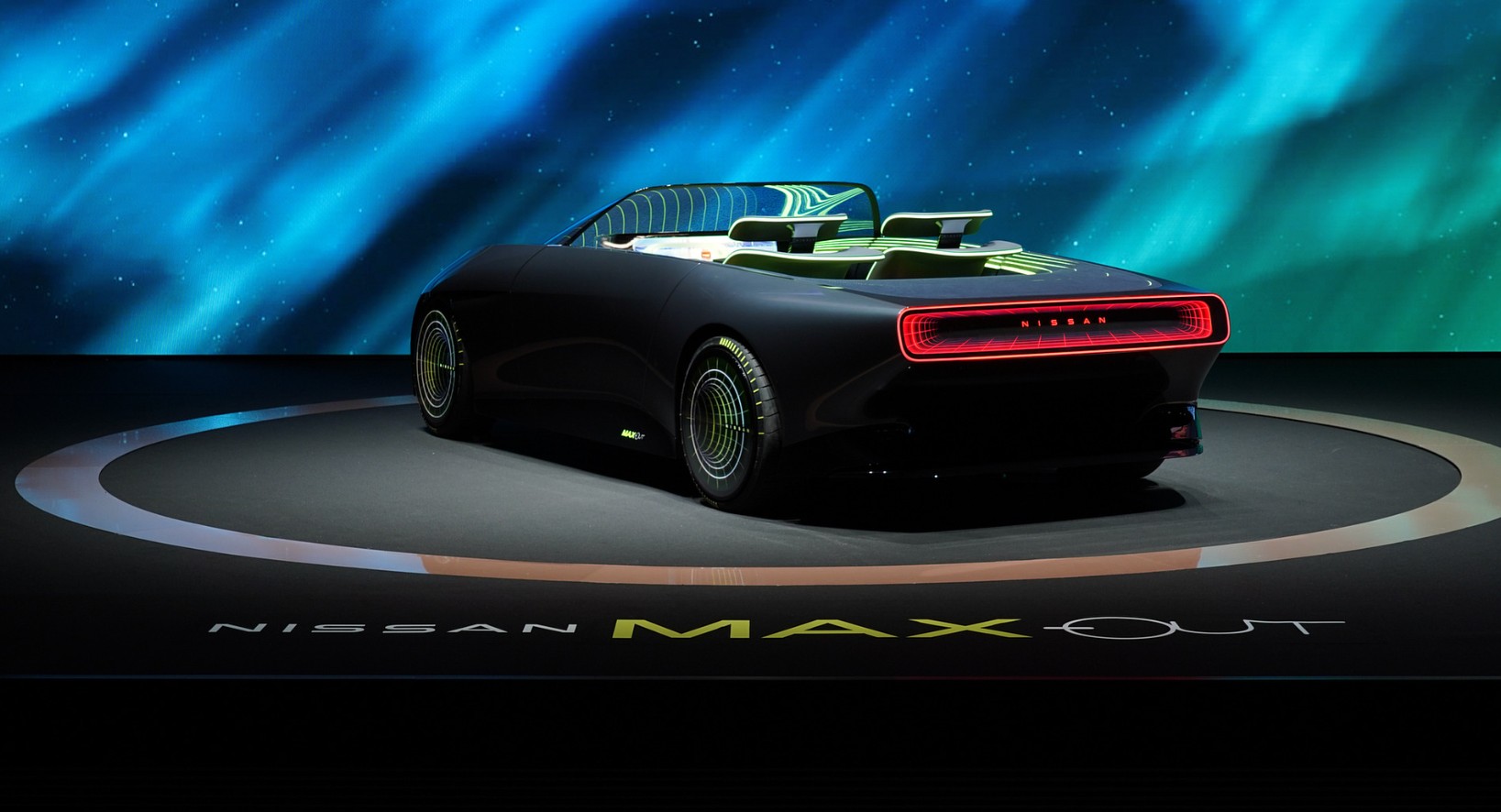
The exterior remains the Max-Out’s most immediately recognizable feature. The concept has an extremely low profile with a broad stance, short visual overhangs and a body that appears to flow continuously from the front fascia toward the rear deck. Traditional grille openings are minimized because an EV does not require the same cooling airflow as an internal-combustion sports car. That allows designers to create a smoother front surface while using lighting and aerodynamic detailing to establish the vehicle’s visual identity.
A production Max-Out would likely retain the two-seat configuration because that is fundamental to the concept’s purpose. The absence of rear seats creates more freedom for a low roofline, a compact cabin and a sculpted rear section. It could also allow Nissan to concentrate heavily on weight distribution and battery packaging. The original concept was described as ultra-lightweight with a very low center of gravity, two characteristics that would be especially valuable in a convertible because additional structural reinforcement can otherwise add considerable mass.
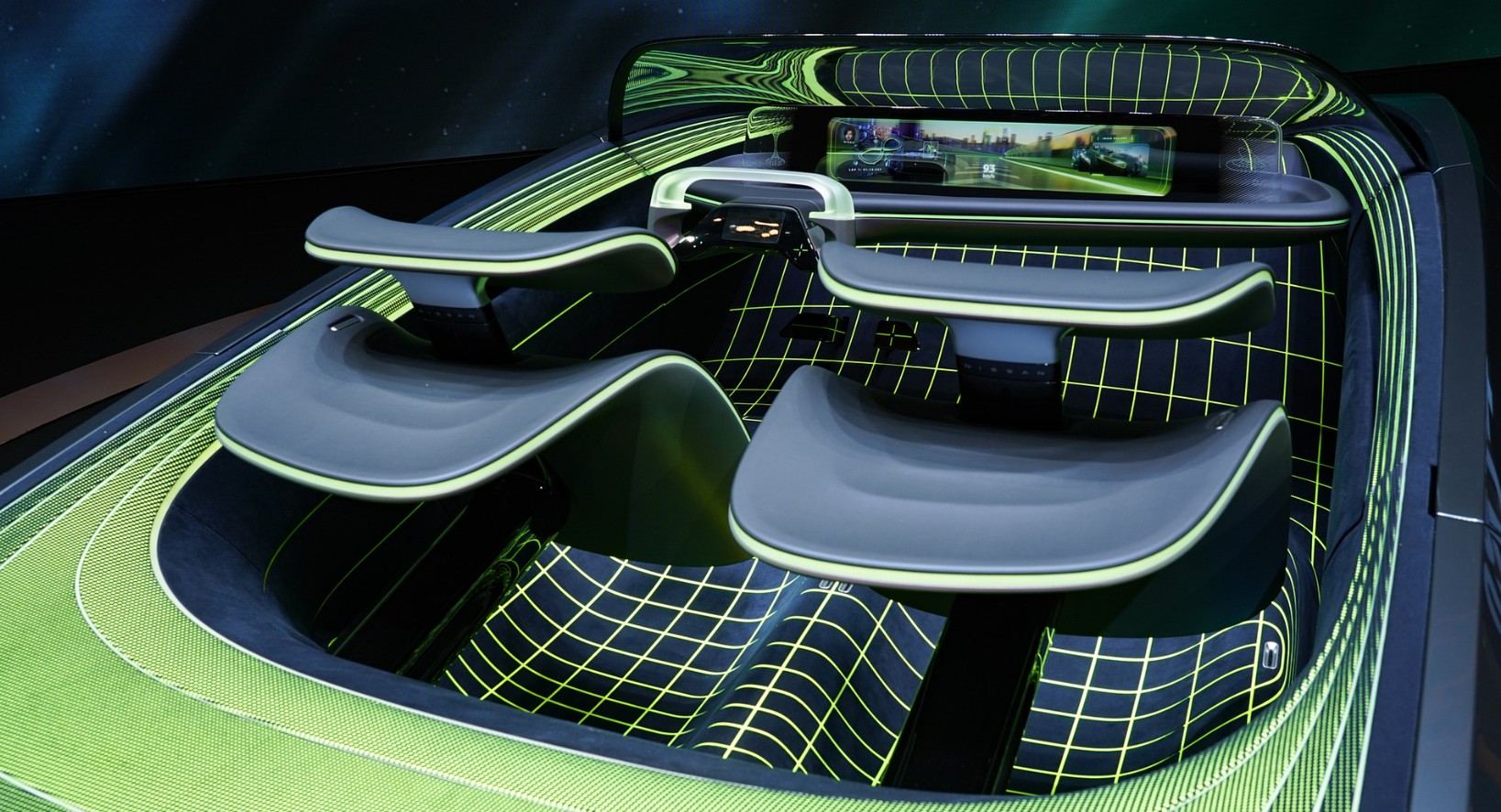
The interior concept is even more unusual. Nissan designed the Max-Out with seats capable of morphing and flattening into the floor, creating additional usable interior space when desired. That is far removed from a traditional roadster interior, where the cabin is generally fixed around the driver and passenger. Whether such a mechanism would survive production is uncertain, but the concept demonstrates Nissan’s interest in treating the interior as a flexible digital and physical environment rather than simply a place to sit.
A future production cabin would probably combine this experimental philosophy with more conventional premium equipment. A large digital instrument display, wide infotainment interface, advanced navigation, wireless smartphone connectivity, premium materials and configurable ambient lighting would fit naturally into the Max-Out’s futuristic personality. The cabin could use a minimalist dashboard with physical controls retained for critical driving functions, while a digital interface handles navigation, energy information, entertainment and vehicle personalization. The overall objective would be a cockpit that feels closer to a modern technology product than a traditional sports car.
The original Max-Out was created specifically as a design exploration rather than a conventional production model. Nissan describes it as a two-seat convertible intended to deliver a liberating feeling of openness and a dynamic driving experience. That basic concept provides the foundation for imagining a future production version: extremely low seating, a long and smooth body, minimal visual clutter and a cabin designed to make the driver feel closely connected to the vehicle.
A production-oriented redesign would almost certainly need to change some of the concept’s more extreme features. Road-going crash regulations, pedestrian protection requirements, production costs, weather sealing, lighting standards and manufacturing constraints would all influence the final shape. The futuristic concept could therefore evolve into something more recognizable as a Nissan while retaining its distinctive proportions. Slim lighting elements, aerodynamic surfaces, a low hood and a wide stance would likely remain central to the vehicle’s identity.
The technology strategy would be particularly important. Nissan’s broader electrification program has included multiple EV concepts under its long-term vision, while the company continues developing battery technology intended to improve range, charging performance and vehicle packaging. Nissan says it aims to launch an EV using its proprietary all-solid-state batteries by fiscal year 2028, meaning a future production sports car could potentially benefit from that technology depending on development timing and vehicle strategy.
The Max-Out could therefore become a showcase for Nissan’s next generation of electric performance rather than simply another battery-powered model. The company’s concept vehicle strategy has already explored high-performance EVs through the Hyper series, while the Max-Out approaches electrification from a completely different direction. A production version would make the most sense if Nissan wanted an emotional flagship capable of demonstrating that electric cars can deliver open-air enjoyment, sophisticated handling and futuristic design alongside practical charging technology. 2027 Nissan Max-Out Redesign
2027 Nissan Max-Out Specs
Engine & Performance
Nissan has not published production powertrain specifications for a 2027 Max-Out. However, the concept’s official fact sheet identifies advanced e-4ORCE as one of its standout technologies. That provides an important clue about the performance philosophy Nissan envisioned. Instead of relying on a conventional rear-wheel-drive layout, a production interpretation could use independently controlled electric motors to distribute torque between the front and rear axles. Such a configuration would offer rapid response and precise control over traction.
Electric propulsion would also suit the Max-Out’s low-slung design. Battery placement beneath the passenger compartment can lower the center of gravity, while electric motors provide immediate torque without the need for a traditional multi-speed transmission. Nissan’s broader EV development work emphasizes the smooth and rapid acceleration response of electric motors, a characteristic the company has refined through years of EV development.
The most interesting target would not necessarily be an extreme 0-to-60-mph number. A lightweight electric convertible with sophisticated torque distribution could instead focus on cornering response, stability and smooth acceleration. Nissan’s original Max-Out documentation specifically mentions dynamic cornering, steering response and limited body roll as part of the concept’s driving philosophy. That suggests the intended experience was about balance and driver confidence rather than simply producing enormous straight-line power.
Battery technology could determine whether a production Max-Out becomes a genuinely compelling grand-touring EV or remains a niche weekend sports car. Nissan is developing all-solid-state battery technology with the stated goal of launching an EV using the technology by fiscal year 2028. The company says such batteries have the potential for approximately twice the energy density of conventional lithium-ion technology and significantly shorter charging times. If the technology reaches production maturity as planned, it could eventually allow Nissan to build a lighter, more compact and longer-range electric sports car.
2027 Nissan Max-Out Fuel Economy
Fuel economy would be measured differently from a gasoline-powered convertible because an electric Max-Out would use an EPA efficiency rating such as MPGe alongside a battery-range figure. The concept has no official EPA rating or production battery specification. A production version could prioritize a relatively large battery for grand-touring range, although excessive battery capacity would add weight. For a lightweight sports convertible, Nissan would have to find a careful balance between range, battery mass, acceleration and handling.
A sensible future lineup would probably remain relatively simple. A Max-Out Performance could serve as the entry model with dual-motor all-wheel drive, while a higher-output Max-Out NISMO could potentially use more powerful motors, upgraded brakes, performance tires and a more aggressive suspension. A long-range Max-Out Touring could prioritize battery capacity and comfort instead. These are hypothetical trim concepts, not Nissan-confirmed grades, but they illustrate how the vehicle could be positioned without turning a niche sports car into an unnecessarily complicated lineup.
2027 Nissan Max-Out Safety Features
Safety equipment would need to become substantially more conventional if the Max-Out entered mass production. Nissan has made advanced driver assistance an important part of its technology strategy, with ProPILOT already deployed across a large number of Nissan and Infiniti vehicles. The company has also been developing next-generation LiDAR technology and has stated ambitions to expand advanced driver-assistance capabilities throughout its lineup. A future Max-Out could therefore combine high-performance vehicle dynamics with sophisticated collision avoidance and highway assistance systems.
Expected safety hardware for a production version could include automatic emergency braking, forward-collision warning, blind-spot monitoring, rear cross-traffic alert, lane-departure assistance, adaptive cruise control and a surround-view camera. More advanced configurations could incorporate newer sensor technologies as they become available. However, none of these features has been confirmed specifically for a production Max-Out, so they should be regarded as reasonable expectations based on Nissan’s broader technology direction rather than announced equipment. 2027 Nissan Max-Out Redesign
2027 Nissan Max-Out Release Date & Price
Pricing is currently impossible to state as an official figure because Nissan has not announced a production Max-Out or a 2027 MSRP. The concept exists as a design and technology exploration, not as a confirmed retail vehicle. A production electric convertible would likely require significant investment in structural engineering, battery packaging, convertible-body reinforcement, weather sealing and specialized manufacturing. Those factors could place it considerably above Nissan’s mainstream EVs if it ever reaches dealerships.
A realistic positioning strategy would place a production Max-Out above the company’s mainstream electric models and potentially near premium electric sports cars. An estimated starting price somewhere in the $60,000-$80,000 range could make sense for a sophisticated dual-motor electric roadster, while a high-performance version could exceed $90,000. However, these numbers are purely speculative and should not be presented as Nissan’s announced pricing. The final price would depend heavily on battery chemistry, motor output, production volume and whether Nissan treats the vehicle as a flagship technology model.
The release date is even less certain. Nissan’s official material identifies Max-Out as a 2023 concept, and the company’s current design gallery still categorizes it as a concept rather than a production vehicle. There is no official Nissan announcement confirming that the Max-Out will enter production as a 2027 model. Therefore, claims that a specific 2027 showroom launch has already been confirmed would go beyond the available evidence.
Even without a confirmed production schedule, the Max-Out remains important to Nissan’s future design story. Nissan continues to describe electrification as a major component of its long-term strategy, while its portfolio strategy emphasizes a more focused lineup and greater powertrain choice. The company is also developing new battery technologies and advanced vehicle intelligence. Those developments create an environment in which an electric sports convertible could eventually become technically feasible, although there is currently no official indication that Max-Out itself will be the vehicle selected for production.
Conclusion
The 2027 Nissan Max-Out is best understood as a glimpse into what Nissan believes an electric performance convertible could become rather than a confirmed production car. The concept’s two-seat layout, ultra-low stance, flexible interior, low center of gravity and advanced e-4ORCE technology give it a distinct identity that separates it from conventional EV crossovers and sedans. Nissan’s official materials clearly position Max-Out as a concept and do not currently provide a production MSRP, EPA range, horsepower figure, trim structure or confirmed 2027 release date.
Its potential becomes more interesting when viewed alongside Nissan’s battery-development program. The company is targeting an EV using its proprietary all-solid-state batteries by fiscal year 2028, with Nissan projecting major advantages in energy density, charging performance and cost. That technology could eventually make a lightweight, high-performance electric roadster more practical, although there is no official statement connecting the Max-Out directly to that future battery program.
If Nissan ultimately decides to bring the Max-Out philosophy into production, the vehicle could become an important statement about the future of driving enjoyment. Instead of treating electrification solely as a solution for efficiency and emissions, the Max-Out concept demonstrates how battery power can be used to create a low, balanced, responsive and genuinely emotional sports car. For now, the 2027 Nissan Max-Out remains an exciting possibility rather than a confirmed production model—but its design and technology provide one of the clearest indications of how Nissan could reinterpret the classic open-top sports car for the electric era.
Note: The details included in this blog post are derived from pre-release material that was accessible when the article was written. If you want the latest information, you should check official sources or call your nearest dealership.
Read Also:
- 2027 Nissan Kicks Release Date, Specs, Interior
- 2027 Nissan Armada Review, Specs, Interior
- 2027 Nissan Ariya NISMO Price, Specs, Dimensions
- 2027 Nissan Frontier Review, Price, Features
- 2027 Nissan GT-R NISMO Special Edition Price, Specs, Interior
Frequently Asked Questions
2027 Nissan Max-Out Redesign, Specs, Interior - The 2027 Nissan Max-Out remains one of the most intriguing names in Nissan's electric-vehicle portfolio, largely because it represents something the modern EV market still lacks: a purpose-built, open-top performance car designed around electric propulsion from the beginning. Nissan introduced the…
There is an important distinction surrounding the 2027 Nissan Max-Out. Nissan has officially presented the Max-Out as a concept car, and the company has not announced a production-specification 2027 Max-Out with confirmed pricing, EPA range, horsepower, trim levels or a showroom launch date. Nissan's own design gallery continues…
That uncertainty does not make the Max-Out irrelevant. Quite the opposite: the concept offers a revealing look at how Nissan imagines an emotionally engaging electric vehicle. The original concept was engineered around lightweight construction, a very low center of gravity and advanced e-4ORCE all-wheel-drive technology. Nissan also envisioned…
If Nissan eventually turns the Max-Out idea into a production vehicle for the 2027 era or beyond, the result could occupy a unique position between a sports car, grand tourer and technology demonstrator. Rather than competing purely on acceleration figures, the Max-Out would have an opportunity to deliver…
2027 Nissan Max-Out Redesign and Update Plan Exterior & Interior The exterior remains the Max-Out's most immediately recognizable feature. The concept has an extremely low profile with a broad stance, short visual overhangs and a body that appears to flow continuously from the front fascia toward the rear…