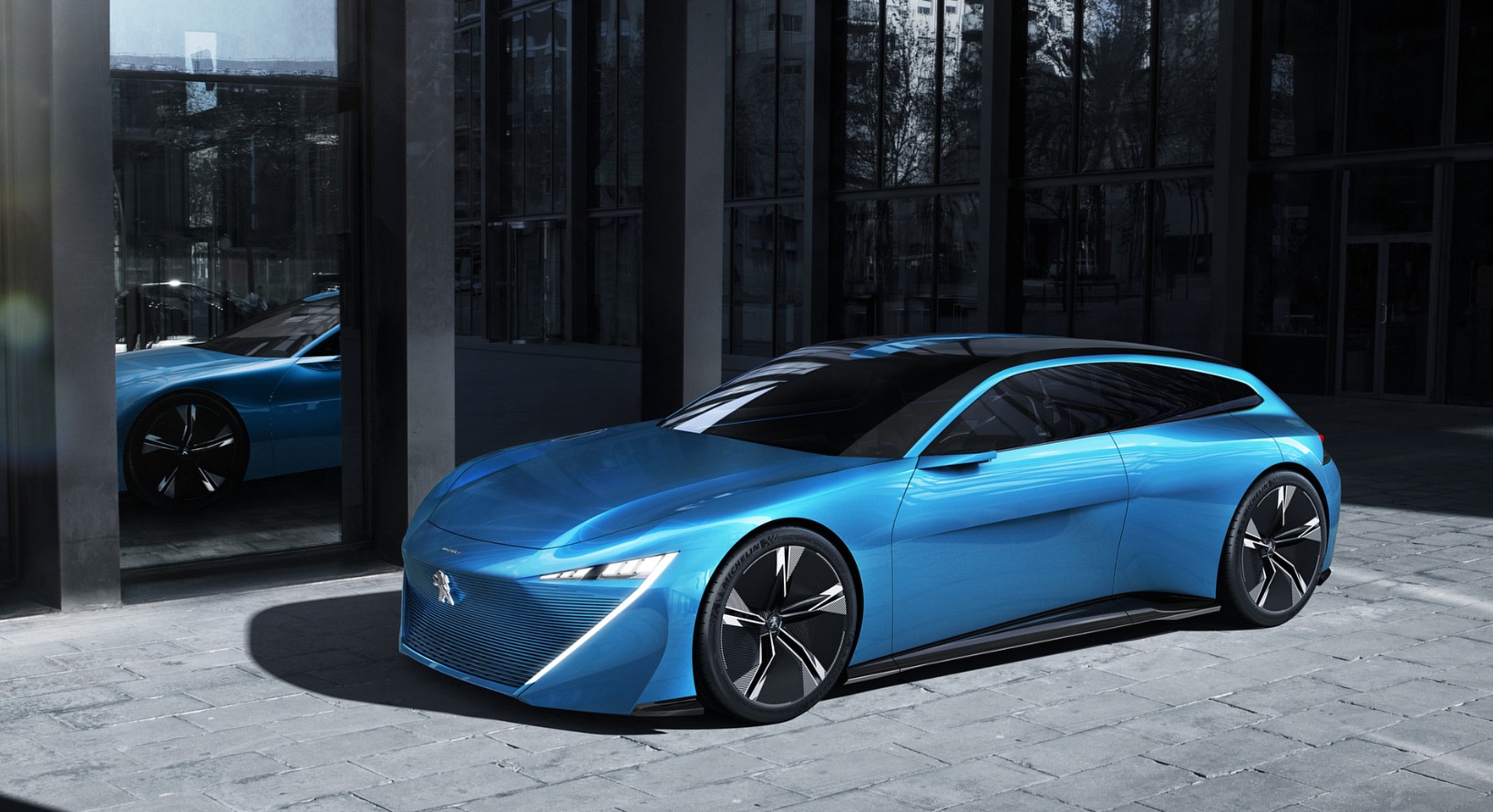
2028 Peugeot Instinct Redesign, Dimensions, Specs – The 2028 Peugeot Instinct is one of those future-car names that immediately creates interest because the Instinct already exists in Peugeot’s concept-car history. Peugeot introduced the Instinct Concept in 2017 as a striking shooting-brake designed to explore autonomous driving, connected technology, personalized mobility, and a new interpretation of the brand’s i-Cockpit philosophy. It was not presented as a conventional production model, and Peugeot has not officially confirmed a 2028 production vehicle carrying the Instinct name. That distinction matters. Nevertheless, the concept provides a fascinating blueprint for what a future Peugeot could become, particularly as the company expands its electric range and develops increasingly sophisticated digital interfaces.
The original Instinct was far more than a styling exercise. Peugeot described it as an autonomous hybrid vehicle with a plug-in-hybrid powertrain producing 300 horsepower, four-wheel drive, and multiple driving modes. Its technology was designed around the idea that the vehicle could understand the driver’s preferences and adapt its behavior accordingly. Four modes—Drive Boost, Drive Relax, Autonomous Soft, and Autonomous Sharp—were created to change the character of the vehicle depending on whether the priority was dynamic driving, assistance, comfort, or journey efficiency. A modern 2028 interpretation could take that philosophy much further with electric propulsion, advanced connectivity, artificial intelligence-assisted interfaces, and a more production-realistic approach to automated driving.
The timing would also make sense from a technology perspective. Peugeot has moved considerably toward electrification since the Instinct Concept was unveiled. The E-3008, for example, uses Stellantis’ STLA Medium platform and is available with electric powertrains offering up to 700 km of WLTP range in Long Range specification. The E-3008 also introduced Peugeot’s Panoramic i-Cockpit and a new generation of digital connectivity. These developments show that many of the ideas explored by the Instinct are no longer purely theoretical. A 2028 Instinct could therefore reinterpret those ideas using technology that has already entered Peugeot’s production vehicles.
For now, the 2028 Peugeot Instinct should be viewed as a future-model projection rather than an announced production car. Peugeot’s official concept-car material continues to list the Instinct among its experimental designs, while newer concepts such as the Inception demonstrate how the company is exploring radically different approaches to electric design and human-machine interaction. If Peugeot eventually revives the Instinct name, a production version would probably not be a literal copy of the 2017 concept. Instead, the most convincing direction would be a sleek electric shooting brake combining expressive French design, long-distance efficiency, fast charging, premium cabin technology, and a genuinely engaging driving experience. 2028 Peugeot Instinct Redesign
2028 Peugeot Instinct Redesign and Update Plan
Exterior & Interior
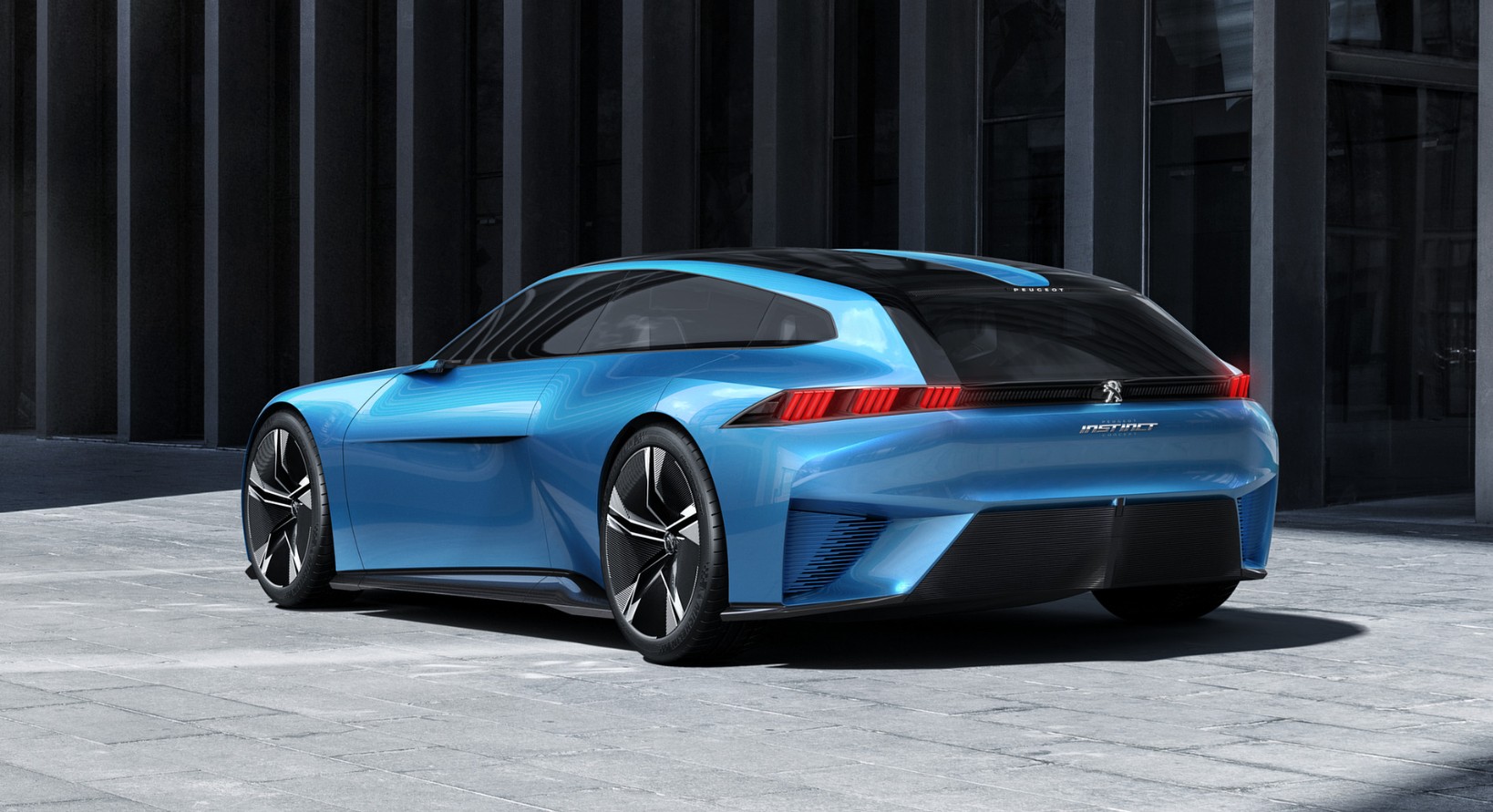
A production-ready 2028 Peugeot Instinct would need to preserve the original concept’s most recognizable characteristic: its elegant shooting-brake silhouette. The 2017 Instinct used a long hood, low roof, pronounced wheel arches, flowing body surfaces, and a practical rear section to create something positioned between a performance coupe, wagon, and grand tourer. Peugeot described its proportions as drawing from traditional coachbuilding, with the long bonnet visually emphasizing the performance of its 300-hp powertrain. A 2028 version could maintain that basic architecture while replacing some of the concept’s extravagant elements with aerodynamic surfaces suitable for mass production and electric efficiency.
The front end could become particularly dramatic. Peugeot’s current design language uses distinctive lighting signatures and a bold interpretation of the lion emblem, while the Instinct Concept already experimented with lighting and cameras integrated into the headlamp assemblies. The original concept even placed a camera lens at the center of each LED headlamp, allowing the system to scan the surrounding environment for driver-assistance functions. A modern interpretation could replace those concept-era ideas with compact high-definition cameras, radar sensors, and lidar where appropriate, integrating them into the bodywork rather than leaving the vehicle covered with visible hardware. Active aerodynamic elements could also help reduce drag at highway speeds.
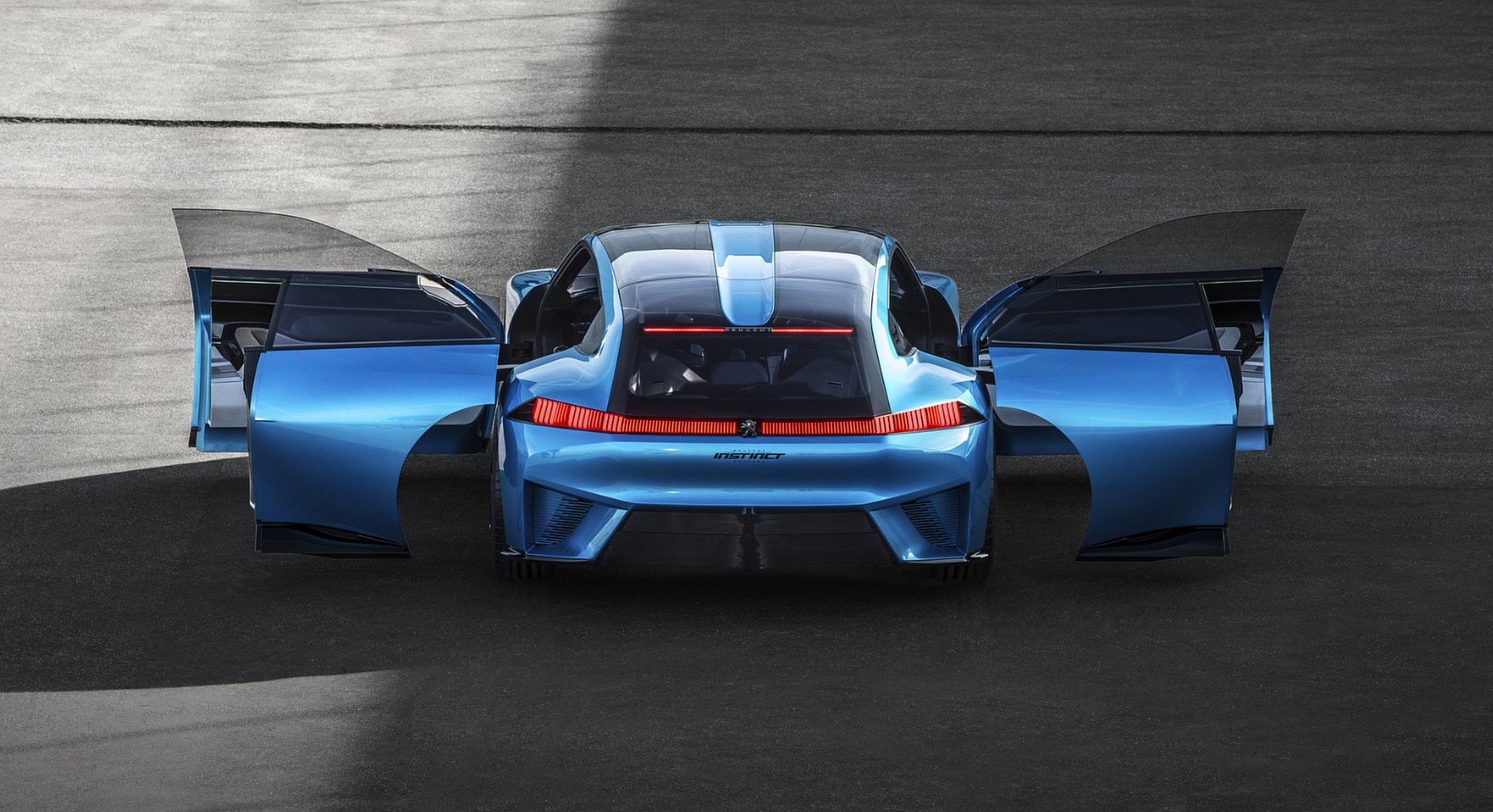
From the side, the 2028 Instinct could look considerably more sophisticated than a conventional family wagon. Large wheels, a long wheelbase, frameless-looking glass, sculpted doors, and a low shoulder line could create a premium grand-tourer appearance. Yet the car should retain enough rear roof height to remain useful. One of the original Instinct’s strengths was the way Peugeot combined an emotional shooting-brake body with practical passenger accommodation. A future version could therefore provide a large rear hatch, configurable cargo floor, underfloor storage for charging equipment, and foldable rear seats. A carefully engineered battery floor could also improve center-of-gravity control without eliminating everyday usability.
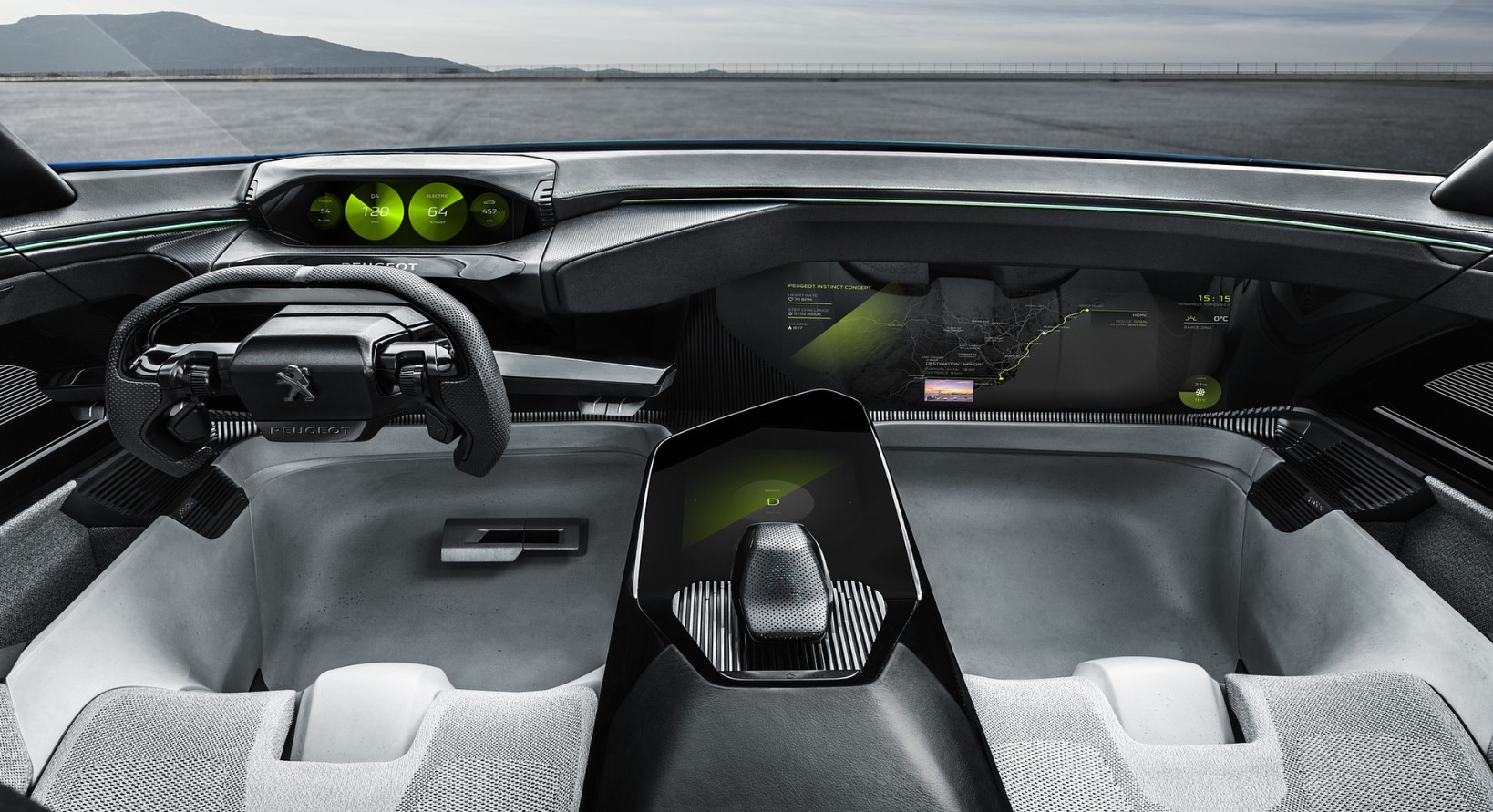
The interior would probably be the most dramatic area of change. The original Instinct featured a highly experimental Responsive i-Cockpit in which the driver’s controls could physically change according to whether the car was being driven manually or operating in autonomous mode. Peugeot described a compact steering wheel and surrounding control panel that could fold into the dashboard, while the accelerator pedal could retract into the pedal unit. A production 2028 model would likely use a less complicated mechanism, but the central philosophy could remain: the cabin should change its presentation according to the driving situation. A large panoramic display, configurable digital instrument panel, augmented-reality navigation, voice control, and intelligent ambient lighting could provide a similar sense of adaptability.
2028 Peugeot Instinct Specs
Engine & Performance
The biggest question surrounding the 2028 Peugeot Instinct is its powertrain. The original concept was a plug-in hybrid with 300 horsepower and four-wheel drive, but the automotive market has moved rapidly toward battery-electric propulsion since 2017. Peugeot’s current electric strategy makes a fully electric Instinct a logical possibility if the name ever returns. The E-3008 already demonstrates that Peugeot can offer a 210-hp front-wheel-drive electric setup, a 230-hp Long Range configuration, and a 320-hp dual-motor all-wheel-drive version. Those figures provide a useful reference point for what a future performance-oriented Peugeot could deliver.
A 2028 Instinct could potentially use a dual-motor configuration as its performance flagship. The existing E-3008 Dual Motor produces a combined 320 horsepower, with a 157-kW front motor and an 83-kW rear motor. A lower, more aerodynamic shooting-brake body could potentially make better use of similar hardware because reduced frontal area and lower weight can improve acceleration, efficiency, and high-speed stability. Exact output cannot be confirmed at this stage, but a power level around or above 300 horsepower would preserve the performance character associated with the original concept. Peugeot could also use torque-vectoring software to make the car feel more agile rather than simply relying on straight-line acceleration.
Battery technology would be equally important. The E-3008 Long Range currently uses a 96.9-kWh usable battery with a 230-hp motor and has an official WLTP range of up to 700 km. The same Long Range battery technology also gives the E-5008 up to 668 km of WLTP range. By 2028, Peugeot could introduce a more energy-dense battery that provides similar or greater range without requiring a dramatically heavier pack. A sleek Instinct body could also benefit from a lower aerodynamic drag coefficient than a conventional SUV. That combination could make the future car particularly attractive as a long-distance electric grand tourer.
Charging performance could become one of the Instinct’s defining strengths. Current E-3008 Long Range models can accept up to 160 kW of DC charging and require approximately 27 minutes to move from 20% to 80% under the specified conditions. Peugeot also introduced battery pre-conditioning on Long Range models to optimize charging performance during long journeys and colder conditions. A 2028 Instinct could improve this further with faster charging hardware, more sophisticated thermal management, intelligent route planning, and automated charging-stop preparation. For a performance-oriented shooting brake, that would be more meaningful than simply increasing horsepower. 2028 Peugeot Instinct Redesign
2028 Peugeot Instinct Fuel Economy
Fuel economy would not be expressed in traditional miles-per-gallon terms if the 2028 Instinct becomes fully electric. Instead, efficiency would be measured through electricity consumption and real-world range. The current E-3008 demonstrates how much range Peugeot can obtain from a modern electric platform, with the Long Range version officially rated for up to 700 km under WLTP testing. A lower shooting-brake body could potentially offer favorable aerodynamic efficiency, although wheel size, tire specification, battery capacity, temperature, speed, and equipment would all influence actual results. Any 2028 figures should therefore be considered estimates until Peugeot publishes official homologation data.
2028 Peugeot Instinct Safety Features
Safety would be central to any production interpretation of the Instinct name. The original concept was designed around autonomous-driving technology and environmental awareness, including cameras integrated into its headlamp assemblies and advanced driver-assistance functions. Peugeot’s concept provided active cruise control, automatic high-beam management, and different autonomous driving modes. A 2028 production car would need to translate that philosophy into systems that comply with the safety and regulatory requirements of its launch markets. Rather than promising unrestricted self-driving capability, Peugeot could focus on increasingly capable supervised driver assistance for highways, traffic jams, parking, and other defined situations.
The vehicle could use a broad sensor suite combining cameras, radar, ultrasonic sensors, and potentially lidar depending on cost and market requirements. Features such as adaptive cruise control, lane centering, automatic emergency braking, blind-spot monitoring, rear cross-traffic assistance, traffic-sign recognition, driver monitoring, and assisted lane changes would be expected in a premium Peugeot of this type. A more advanced system could also use high-definition navigation data to anticipate curves, speed changes, intersections, and charging stations. The original Instinct’s ability to adapt its behavior to the driver’s selected mode could therefore evolve into a much more sophisticated software-defined vehicle architecture.
Connectivity could be one of the strongest links between the original Instinct and a future production model. The concept was developed around an Internet of Things architecture that connected the vehicle with a user’s digital ecosystem. Peugeot described a system that could combine information from smartphones, smartwatches, home devices, entertainment services, and other connected products to create a personalized user profile. A 2028 version could deliver the same concept through modern cloud services, smartphone integration, digital keys, remote climate control, over-the-air software updates, intelligent charging schedules, personalized navigation, and user profiles stored securely in the vehicle. The car could recognize different drivers and automatically load preferred seating, climate, display, and driving settings.
2028 Peugeot Instinct Release Date & Price
If Peugeot ever turns the Instinct into a production model for 2028, the trim strategy would likely be much simpler than the extensive range used by mainstream SUVs. A logical lineup could begin with an Instinct Allure focused on design, efficiency, and long-distance usability, followed by a GT version offering stronger equipment, larger wheels, premium interior materials, and additional technology. A GT Performance or Peugeot Sport-inspired flagship could potentially use dual-motor all-wheel drive, more aggressive suspension tuning, larger brakes, and a higher-output electric powertrain. These names are speculative, however, because Peugeot has not announced production trims for a 2028 Instinct.
Pricing would depend heavily on the platform, battery size, production volume, and equipment level. The existing E-3008 provides a useful reference because Peugeot positioned it as a premium-feeling electric SUV while maintaining a broader market position. The E-3008’s STLA Medium platform can accommodate batteries with substantial energy capacity and supports multiple electric powertrains, including a 320-hp dual-motor version. A production Instinct would probably need to sit above the mainstream E-3008 if it offered a lower-volume shooting-brake body, more advanced cabin technology, premium materials, and performance-focused hardware. A hypothetical entry point around the €55,000–€65,000 range would therefore be conceivable in Europe, while highly equipped versions could move considerably higher. Those figures are estimates, not announced Peugeot pricing.
The release date is even less certain. Peugeot has not announced a 2028 Instinct production program, and the original Instinct remains officially categorized as a concept vehicle. If the name were revived, an unveiling could theoretically happen before the 2028 model year followed by market launches in selected regions. However, the more realistic expectation is that Peugeot will continue transferring individual Instinct ideas into production vehicles rather than simply reproducing the concept. The E-3008 already demonstrates the company’s progress in electric platforms, long-range batteries, advanced i-Cockpit technology, and software-based vehicle functions. The future Instinct, if approved, would likely combine these mature technologies into a more emotional body style. 2028 Peugeot Instinct Redesign
Conclusion
The 2028 Peugeot Instinct remains an intriguing possibility rather than a confirmed production car, but the original concept gives the name a remarkably strong foundation. Its shooting-brake proportions, 300-hp plug-in-hybrid powertrain, four-wheel drive, responsive i-Cockpit, personalized driving modes, and autonomous-driving research were ambitious when the concept appeared. By 2028, many of those ideas could be expressed through technologies that Peugeot already uses in production, including long-range electric propulsion, dual-motor AWD, fast DC charging, advanced digital interfaces, and connected services. The most compelling interpretation would not simply recreate the old concept. It would transform its original philosophy into a sleek, efficient, high-performance electric shooting brake that combines French design character with genuinely useful modern technology.
Note: The details included in this blog post are derived from pre-release material that was accessible when the article was written. If you want the latest information, you should check official sources or call your nearest dealership.
Read Also:
- 2027 Peugeot e-Legend Release Date, Price, Specs
- 2027 Peugeot 3008 Release Date, Specs, Configurations
- 2027 Peugeot e-2008 Release Date, Price, Configurations
- 2027 Peugeot e-2008 Specs, Price, Release Date
- 2027 Peugeot Fractal Review, Specs, Interior
Frequently Asked Questions
2028 Peugeot Instinct Redesign, Dimensions, Specs - The 2028 Peugeot Instinct is one of those future-car names that immediately creates interest because the Instinct already exists in Peugeot's concept-car history. Peugeot introduced the Instinct Concept in 2017 as a striking shooting-brake designed to explore autonomous driving, connected technology,…
The original Instinct was far more than a styling exercise. Peugeot described it as an autonomous hybrid vehicle with a plug-in-hybrid powertrain producing 300 horsepower, four-wheel drive, and multiple driving modes. Its technology was designed around the idea that the vehicle could understand the driver's preferences and adapt…
The timing would also make sense from a technology perspective. Peugeot has moved considerably toward electrification since the Instinct Concept was unveiled. The E-3008, for example, uses Stellantis' STLA Medium platform and is available with electric powertrains offering up to 700 km of WLTP range in Long Range…
For now, the 2028 Peugeot Instinct should be viewed as a future-model projection rather than an announced production car. Peugeot's official concept-car material continues to list the Instinct among its experimental designs, while newer concepts such as the Inception demonstrate how the company is exploring radically different approaches…
2028 Peugeot Instinct Redesign and Update Plan Exterior & Interior A production-ready 2028 Peugeot Instinct would need to preserve the original concept's most recognizable characteristic: its elegant shooting-brake silhouette. The 2017 Instinct used a long hood, low roof, pronounced wheel arches, flowing body surfaces, and a practical rear…