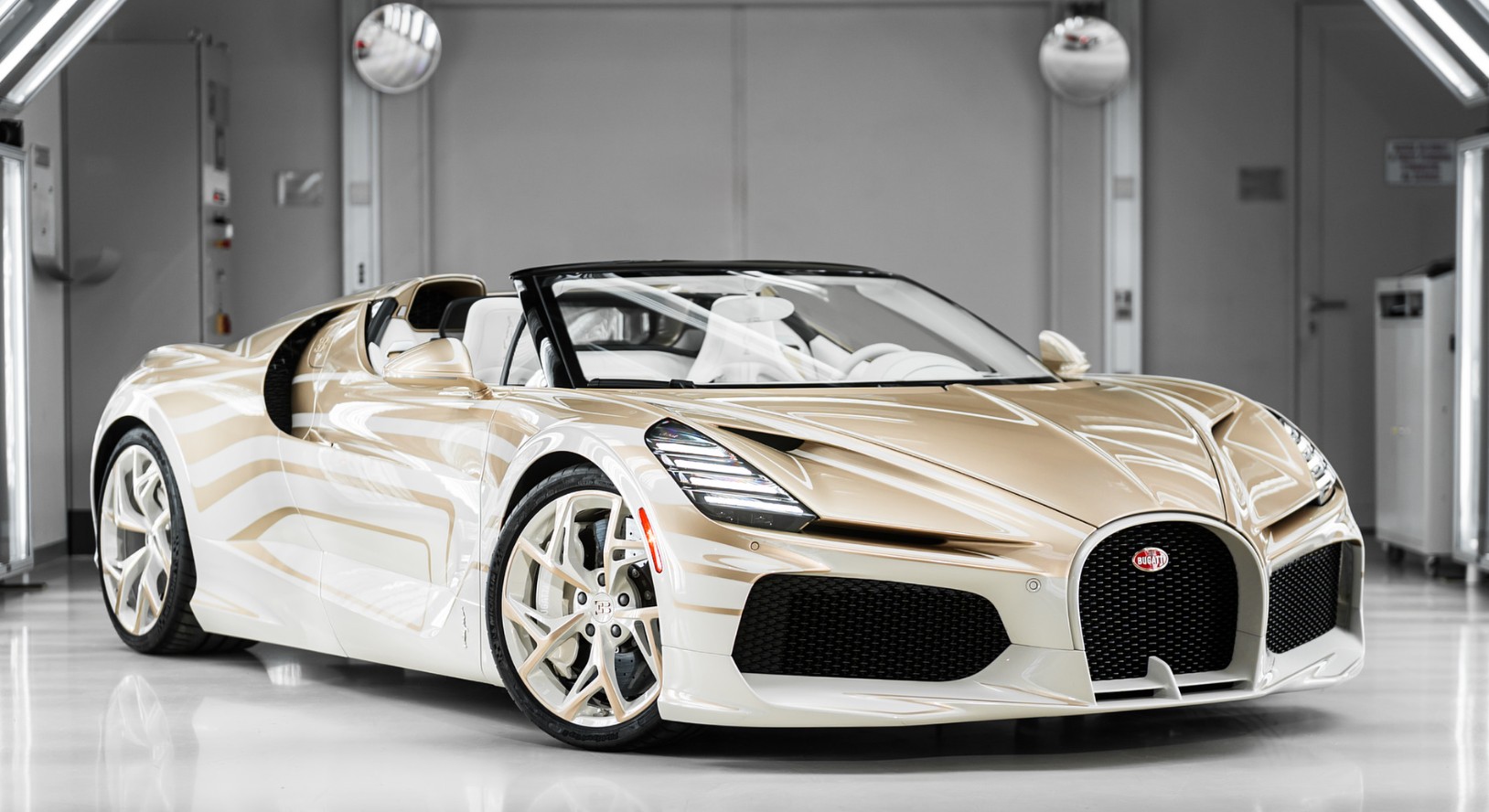
2027 Bugatti W16 Mistral La Perle Rare Review, Specs, Interior – The 2027 Bugatti W16 Mistral La Perle Rare represents one of the most extraordinary chapters in modern Bugatti history: a one-of-one interpretation of the W16 Mistral created through Bugatti’s Sur Mesure personalization program. Unlike a conventional special edition that simply adds a different paint color or a handful of accessories, La Perle Rare was developed as a deeply personalized automotive commission. Its identity comes from a combination of bespoke colors, hand-applied graphics, individually crafted details and Bugatti heritage references. The project began after a meeting between the customer and Bugatti’s Sur Mesure team at Pebble Beach in August 2023, eventually becoming a singular expression of the Mistral’s open-top design and the final chapter of the road-going W16 era.
The timing makes the car even more significant. In July 2026, Bugatti announced that production of the W16 Mistral had ended, with the final Mistral leaving the Molsheim Atelier. That makes any discussion of a “2027” La Perle Rare fundamentally different from discussing a normal upcoming model. This is not a future mass-production vehicle waiting for dealerships. La Perle Rare is an individual commissioned automobile, and the W16 Mistral production run itself was limited to 99 cars. Every example had already been allocated before the model was publicly revealed, with Bugatti announcing a net price of €5 million per car at launch.
The underlying Mistral is equally remarkable. It uses Bugatti’s 8.0-liter quad-turbocharged W16 in its 1,600 PS specification, the same fundamental powertrain lineage associated with the Chiron Super Sport 300+. Bugatti developed the Mistral as an entirely bespoke roadster rather than simply removing the roof from a Chiron. Its monocoque was reengineered, its cooling system redesigned, and its aerodynamic package carefully optimized for open-top operation at extreme speed. Bugatti originally stated a 420 km/h target, while the vehicle was engineered around the ability to combine extraordinary velocity with high-speed stability and the refinement expected from the marque.
La Perle Rare adds another layer to that already exceptional engineering. The name translates to “The Rare Pearl,” and the design centers on an unusual two-tone composition inspired by Bugatti’s hand-painted “Vagues de Lumière” aesthetic. A warm, gold-infused upper body contrasts with a refined warm-white lower section, separated by intricate lines applied through an exceptionally labor-intensive painting process. Bugatti says hundreds of hours of craftsmanship went into the masking and painting alone. The same visual language continues through the cabin, engine cover, wheels and smaller details, making La Perle Rare less like a decorated Mistral and more like a completely individualized piece of automotive art. 2027 Bugatti W16 Mistral La Perle Rare Review
2027 Bugatti W16 Mistral La Perle Rare Redesign and Update Plan
Exterior & Interior
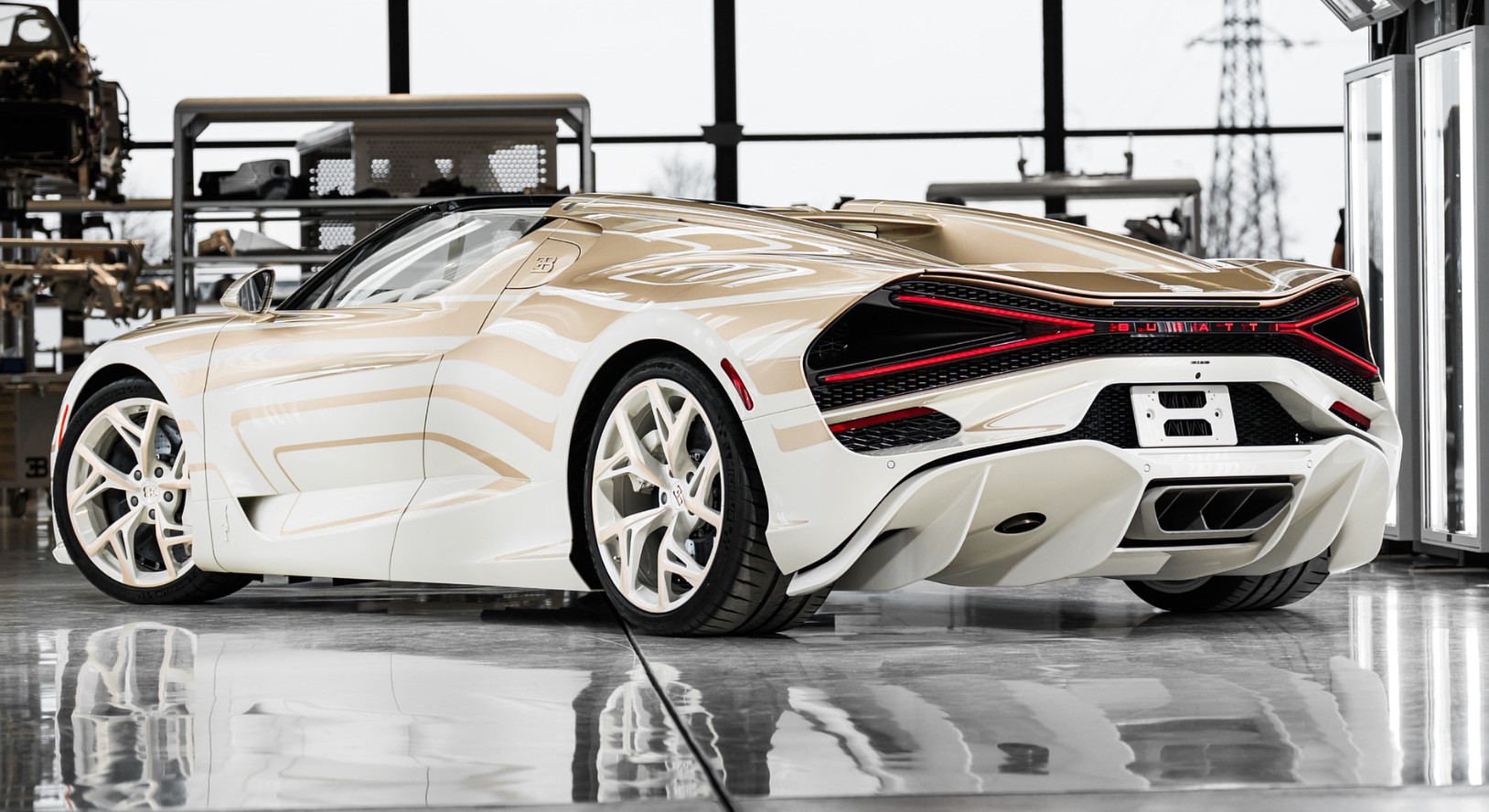
The exterior of the Bugatti W16 Mistral La Perle Rare is dominated by its pearlescent two-tone appearance. The warm upper color flows over the bodywork while the refined white lower section gives the car a bright, almost sculptural presence. Rather than relying on a conventional racing stripe, Bugatti created flowing dividing lines inspired by the “Vagues de Lumière” philosophy. The lines emphasize the Mistral’s long surfaces and help visually connect the front, side and rear sections. Under changing light, the metallic elements can alter the way the body appears, giving the car a dynamic quality even when it is stationary.
The underlying Mistral design is already highly functional. Its widened three-dimensional horseshoe grille supplies critical air to the central radiator, while specially shaped headlamp structures help direct airflow around the front corners. Air entering through the sides is routed toward radiators and eventually exhausted through the dramatic X-shaped taillights. Behind the occupants, the large air intakes do more than create an aggressive silhouette: they feed the W16 and form part of the vehicle’s aerodynamic and thermal strategy. This is a perfect example of Bugatti’s “form follows performance” philosophy, where dramatic visual elements also perform important engineering functions.
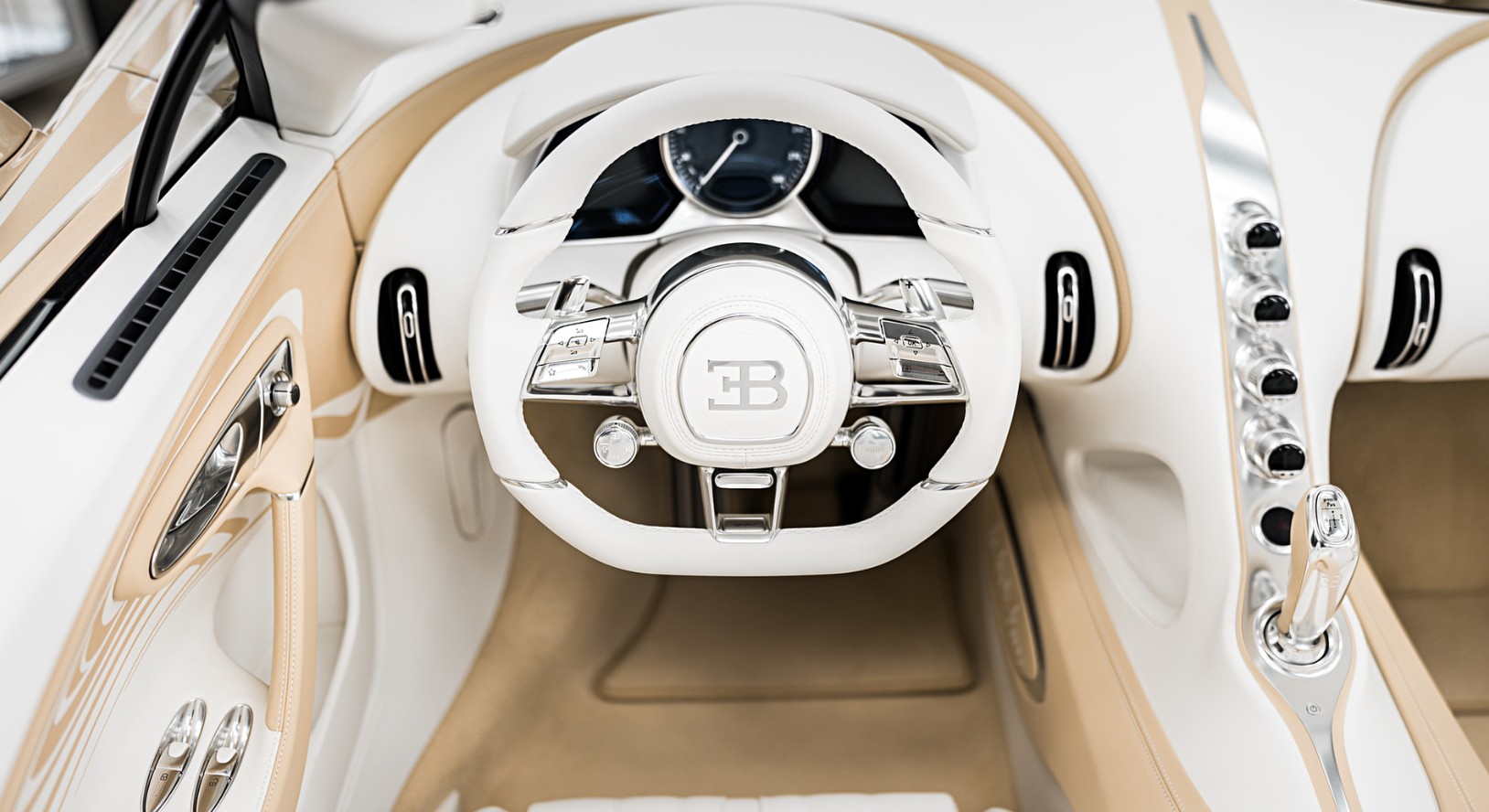
La Perle Rare’s wheels receive their own bespoke interpretation of the white-and-gold theme, reinforcing the relationship between the rotating components and the bodywork. The result is more sophisticated than simply fitting contrasting wheels. Every visible surface is treated as part of a single composition. The rear wing, engine cover and exterior signatures continue the same visual vocabulary, while the open cockpit leaves much of the cabin visible from outside. That makes interior customization especially important because the Mistral is not a closed vehicle where the cabin disappears behind tinted glass. The exterior and interior effectively become one continuous presentation.
Inside, the La Perle Rare theme becomes even more intimate. White-painted carbon elements are combined with gold-and-white door detailing, polished aluminum and carefully integrated ambient lighting. The cabin includes intricate leatherwork and bespoke surfaces that continue the vehicle’s visual theme. The central tunnel receives personalized “La Perle Rare” detailing, while the gear selector incorporates Bugatti’s heritage-inspired Dancing Elephant reference. This level of personalization goes far beyond choosing an upholstery color from a catalog. It represents a collaborative design process in which the client, designers and craftspeople refine individual elements until the finished automobile reflects a specific vision.
Calling La Perle Rare a “redesign” requires some precision because its mechanical foundation remains the W16 Mistral rather than a newly engineered successor. The underlying car was already extensively reworked from the Chiron architecture to become a proper roadster, with an altered monocoque, revised body structure and dedicated aerodynamic solutions. La Perle Rare then takes that finished hypercar and applies an extraordinary Sur Mesure treatment. In other words, the update is primarily artistic and bespoke rather than a new-generation mechanical program. Bugatti’s own description emphasizes the individualization process and the collaboration between its design specialists and the commissioning client.
The central design concept is based on light, reflection and the natural beauty of a pearl. Bugatti’s team initially explored different directions before settling on two newly developed colors. The upper surfaces receive a warm, gold-infused shade designed to change subtly with the light, while the lower body uses a refined warm white. The separation between those colors is not a simple factory stripe. It was created through meticulous hand-applied masking and painting, with hundreds of hours devoted to achieving the required precision. This makes every curve, transition and reflection part of the design rather than merely an afterthought.
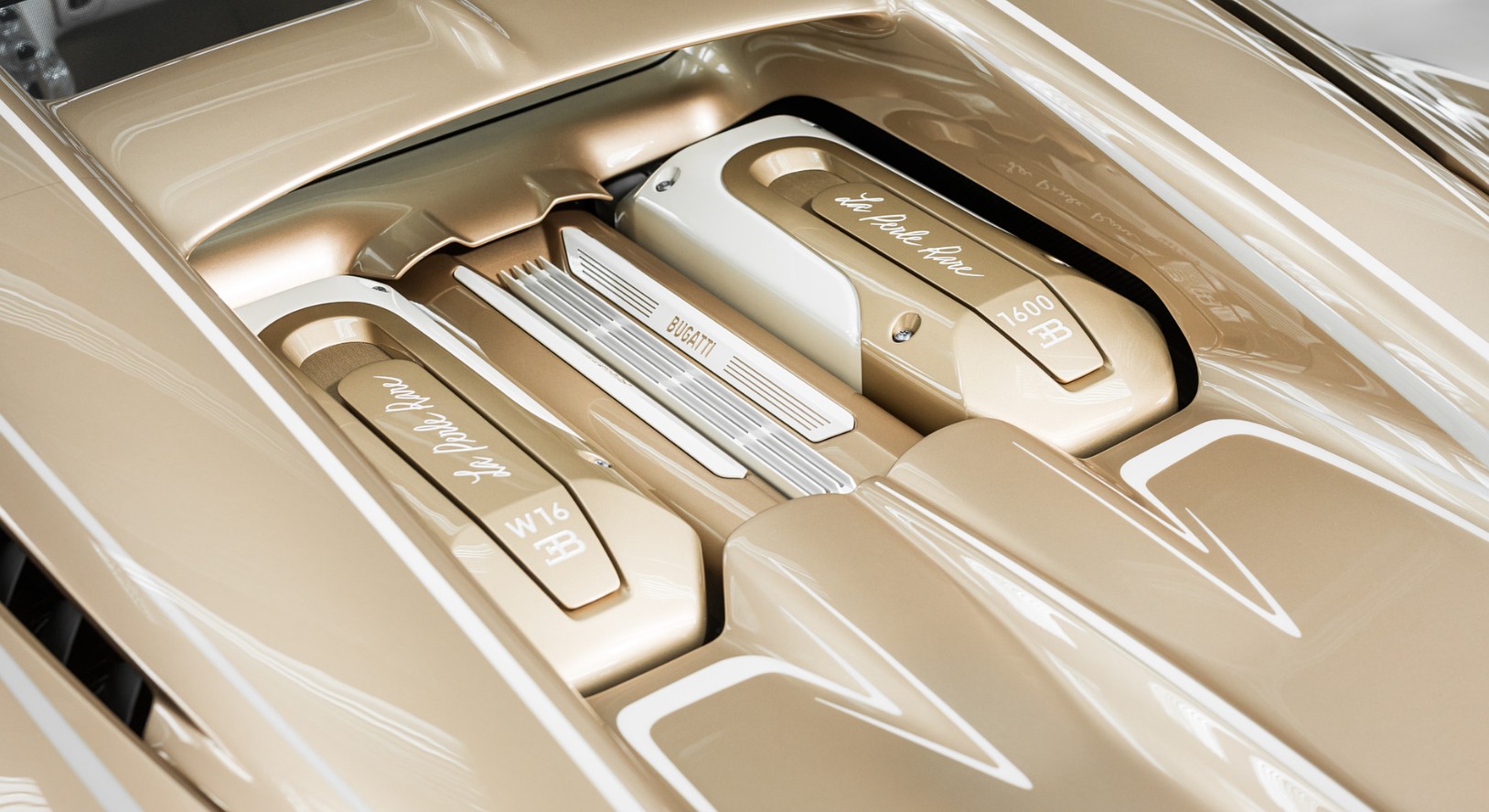
The white-and-gold theme also extends into components that normally receive much less attention. The engine cover receives bespoke treatment, while the rear wing carries a painted signature associated with the project. The “La Perle Rare” name itself appears in the customer-specific detailing, including stitched elements along the central tunnel and engravings. The effect is intentionally cohesive: the same visual idea appears repeatedly without making the vehicle look overloaded with decoration. That restraint matters because the Mistral’s original form is already dramatic. La Perle Rare works by emphasizing its sculptural surfaces rather than hiding them beneath excessive ornamentation.
A particularly meaningful update is the incorporation of Bugatti’s heritage into the bespoke design. Rembrandt Bugatti’s famous Dancing Elephant sculpture appears as a motif within the gear selector casing and on the exterior bodywork behind the front wheels. This reference is not random. The Dancing Elephant has a direct connection to the legendary Type 41 Royale, creating a bridge between the marque’s historic coachbuilding tradition and its modern Sur Mesure program. The 2027 La Perle Rare therefore sits at the intersection of three ideas: the historic Bugatti roadster, the modern W16 hypercar and the highly individualized future of luxury automotive craftsmanship. 2027 Bugatti W16 Mistral La Perle Rare Review
2027 Bugatti W16 Mistral La Perle Rare Specs
Engine & Performance
At the center of the Mistral is Bugatti’s legendary 8.0-liter quad-turbocharged W16, producing 1,600 PS. This is the definitive high-output version of the W16 used in the Mistral, derived from the powertrain that powered the Chiron Super Sport 300+. The engine uses four turbochargers and sixteen cylinders arranged in the distinctive W configuration that became synonymous with Bugatti’s modern era. For La Perle Rare, there is no need for an additional performance upgrade because the standard Mistral powertrain already represents one of the most extreme road-going internal-combustion engines ever developed.
The performance target is extraordinary for an open-top automobile. Bugatti engineered the W16 Mistral for a 420 km/h top speed, or approximately 261 mph, while the engineering program also considered the aerodynamic and structural challenges of operating a roofless hypercar at extreme velocity. Bugatti’s development work focused on maintaining stability, cooling and occupant protection simultaneously. The aerodynamic system uses a front splitter, carefully shaped underbody, rear diffuser and adjustable rear wing to balance drag and downforce. In Top Speed mode, the rear wing uses a low-drag setting while the diffuser continues contributing useful stability.
The Mistral’s performance is particularly impressive because opening the roof creates major engineering complications. A conventional closed hypercar benefits from its roof as part of the overall body structure and aerodynamic package. Bugatti instead developed a reengineered monocoque specifically for the roadster, creating a rounded open-top silhouette without simply cutting away the Chiron’s roof. The engineers also had to develop new air-management systems because the roofless configuration changes pressure, airflow and cooling behavior around the cockpit. Behind the seats, the large air scoops help feed the engine while also incorporating carbon-fiber crash structures capable of supporting the vehicle during a rollover.
2027 Bugatti W16 Mistral La Perle Rare Fuel Economy
Fuel economy is hardly the primary purchasing consideration for a 1,600-PS Bugatti, but the official figures are still worth documenting. Bugatti lists the W16 Mistral at 21.8 L/100 km combined under WLTP, with phase figures of 40.7 L/100 km in the low phase, 21.9 L/100 km in the medium phase, 18.3 L/100 km in the high phase and 17.6 L/100 km in the extra-high phase. Combined CO2 emissions are listed at 495 g/km, with an efficiency class of G. These numbers place the Mistral firmly in the hypercar category where enormous performance and fuel consumption coexist rather than compete on efficiency.
For La Perle Rare specifically, there is no separate engine trim or efficiency package. It remains mechanically based on the W16 Mistral, meaning the bespoke nature of the car does not translate into a separate powertrain. That distinction is important when describing the vehicle online. La Perle Rare is best understood as a one-off Sur Mesure commission rather than a new production trim positioned above a standard Mistral. Its value comes from exclusivity, craftsmanship, personalization and provenance. The mechanical specification remains extraordinary, but the personalization is what makes this individual car different from the other 98 Mistrals.
2027 Bugatti W16 Mistral La Perle Rare Safety Features
Safety development was therefore treated as a central engineering requirement rather than an optional feature. Bugatti subjected the Mistral to extensive testing, including aerodynamic evaluations, powertrain and transmission dynamometer testing, endurance testing and rigorous crash testing. The company confirmed that the crash tests successfully demonstrated occupant protection and supported compliance with stringent international requirements, including standards relevant to European and North American markets. For a roofless car capable of more than 400 km/h, that structural work is critical.
The Mistral’s carbon-fiber architecture and reinforced air-intake structures are examples of how safety engineering has been integrated into the design rather than added after the styling was completed.At the center of the Mistral is Bugatti’s legendary 8.0-liter quad-turbocharged W16, producing 1,600 PS. This is the definitive high-output version of the W16 used in the Mistral, derived from the powertrain that powered the Chiron Super Sport 300+.
The engine uses four turbochargers and sixteen cylinders arranged in the distinctive W configuration that became synonymous with Bugatti’s modern era. For La Perle Rare, there is no need for an additional performance upgrade because the standard Mistral powertrain already represents one of the most extreme road-going internal-combustion engines ever developed.
The performance target is extraordinary for an open-top automobile. Bugatti engineered the W16 Mistral for a 420 km/h top speed, or approximately 261 mph, while the engineering program also considered the aerodynamic and structural challenges of operating a roofless hypercar at extreme velocity. Bugatti’s development work focused on maintaining stability, cooling and occupant protection simultaneously. The aerodynamic system uses a front splitter, carefully shaped underbody, rear diffuser and adjustable rear wing to balance drag and downforce. In Top Speed mode, the rear wing uses a low-drag setting while the diffuser continues contributing useful stability.
The Mistral’s performance is particularly impressive because opening the roof creates major engineering complications. A conventional closed hypercar benefits from its roof as part of the overall body structure and aerodynamic package. Bugatti instead developed a reengineered monocoque specifically for the roadster, creating a rounded open-top silhouette without simply cutting away the Chiron’s roof. The engineers also had to develop new air-management systems because the roofless configuration changes pressure, airflow and cooling behavior around the cockpit. Behind the seats, the large air scoops help feed the engine while also incorporating carbon-fiber crash structures capable of supporting the vehicle during a rollover. 2027 Bugatti W16 Mistral La Perle Rare Review
2027 Bugatti W16 Mistral La Perle Rare Release Date & Price
The original W16 Mistral carried a starting price of €5 million net, and all 99 examples were sold before the car was officially revealed to the public. That price applied to the Mistral production model, not to a publicly listed retail price for La Perle Rare. Because La Perle Rare is a one-off Sur Mesure commission with extensive bespoke development and craftsmanship, its actual transaction value has not been publicly disclosed by Bugatti. Any article claiming a confirmed final purchase price without an official Bugatti statement would therefore be speculative. A more accurate description is that La Perle Rare sits above the already extraordinary €5 million baseline of the standard Mistral in terms of bespoke exclusivity, while its exact cost remains private.
The release story is equally unusual. The W16 Mistral was originally unveiled in August 2022, with deliveries planned from 2024 and the full 99-car production allocation already sold. La Perle Rare emerged from a personalization journey that began in August 2023, when the commissioning client met Bugatti’s Sur Mesure manager at Pebble Beach. Bugatti formally revealed the one-off creation in February 2026. Then, in July 2026, the company announced the completion of W16 Mistral production. Consequently, there is no conventional “2027 release date” for La Perle Rare. The car already exists as a completed, singular commission, while 2027 represents its status as an exceptionally rare collector automobile rather than the launch year of a new model.
Conclusion
The 2027 Bugatti W16 Mistral La Perle Rare is not important simply because it is expensive or fast. Its significance comes from the combination of exclusivity, engineering and timing. It represents an individual expression of a car that already marked the end of Bugatti’s road-going W16 chapter. With production now complete, the Mistral has become a closed chapter in the company’s history, and La Perle Rare stands among its most visually distinctive interpretations.
The mechanical foundation remains astonishing: an 8.0-liter quad-turbocharged W16 producing 1,600 PS, a 420 km/h target, sophisticated aerodynamic management and a structure developed specifically for open-top operation. Bugatti did not simply remove the roof from an existing Chiron. The Mistral required a reengineered monocoque, new air-intake architecture, dedicated cooling solutions and extensive safety testing. That technical foundation gives La Perle Rare credibility beyond its extraordinary appearance.
The Sur Mesure treatment then turns an already rare hypercar into something even more individual. Its newly developed warm gold and warm white colors, hand-applied dividing lines, personalized signatures, white-and-gold interior, polished aluminum, bespoke carbon elements and Dancing Elephant references create a vehicle with its own visual identity. Hundreds of hours of craftsmanship were dedicated to the paintwork alone, reinforcing the idea that this is closer to a commissioned work of automotive art than a conventional factory special edition.
For collectors, the most important fact is simple: there will not be another La Perle Rare. The Mistral production run is finished, all 99 standard allocations were sold years ago, and this particular Sur Mesure commission occupies its own place within Bugatti history. The car combines the final road-going W16 generation with one of the marque’s most elaborate personalization philosophies. In 2027, its appeal will therefore be less about being the newest Bugatti and more about being an irreplaceable artifact from the end of the W16 era.
Note: The details included in this blog post are derived from pre-release material that was accessible when the article was written. If you want the latest information, you should check official sources or call your nearest dealership.
Frequently Asked Questions
2027 Bugatti W16 Mistral La Perle Rare Review, Specs, Interior - The 2027 Bugatti W16 Mistral La Perle Rare represents one of the most extraordinary chapters in modern Bugatti history: a one-of-one interpretation of the W16 Mistral created through Bugatti’s Sur Mesure personalization program. Unlike a conventional special…
The timing makes the car even more significant. In July 2026, Bugatti announced that production of the W16 Mistral had ended, with the final Mistral leaving the Molsheim Atelier. That makes any discussion of a “2027” La Perle Rare fundamentally different from discussing a normal upcoming model. This…
The underlying Mistral is equally remarkable. It uses Bugatti’s 8.0-liter quad-turbocharged W16 in its 1,600 PS specification, the same fundamental powertrain lineage associated with the Chiron Super Sport 300+. Bugatti developed the Mistral as an entirely bespoke roadster rather than simply removing the roof from a Chiron. Its…
La Perle Rare adds another layer to that already exceptional engineering. The name translates to “The Rare Pearl,” and the design centers on an unusual two-tone composition inspired by Bugatti’s hand-painted “Vagues de Lumière” aesthetic. A warm, gold-infused upper body contrasts with a refined warm-white lower section, separated…
Fuel economy is hardly the primary purchasing consideration for a 1,600-PS Bugatti, but the official figures are still worth documenting. Bugatti lists the W16 Mistral at 21.8 L/100 km combined under WLTP, with phase figures of 40.7 L/100 km in the low phase, 21.9 L/100 km in the medium phase, 18.3 L/100 km in the high phase and 17.6 L/100 km in the extra-high phase. Combined CO2 emissions are listed at 495 g/km, with an efficiency class of G. These numbers place the Mistral firmly in the hypercar category where enormous performance and fuel consumption coexist rather than compete on efficiency.