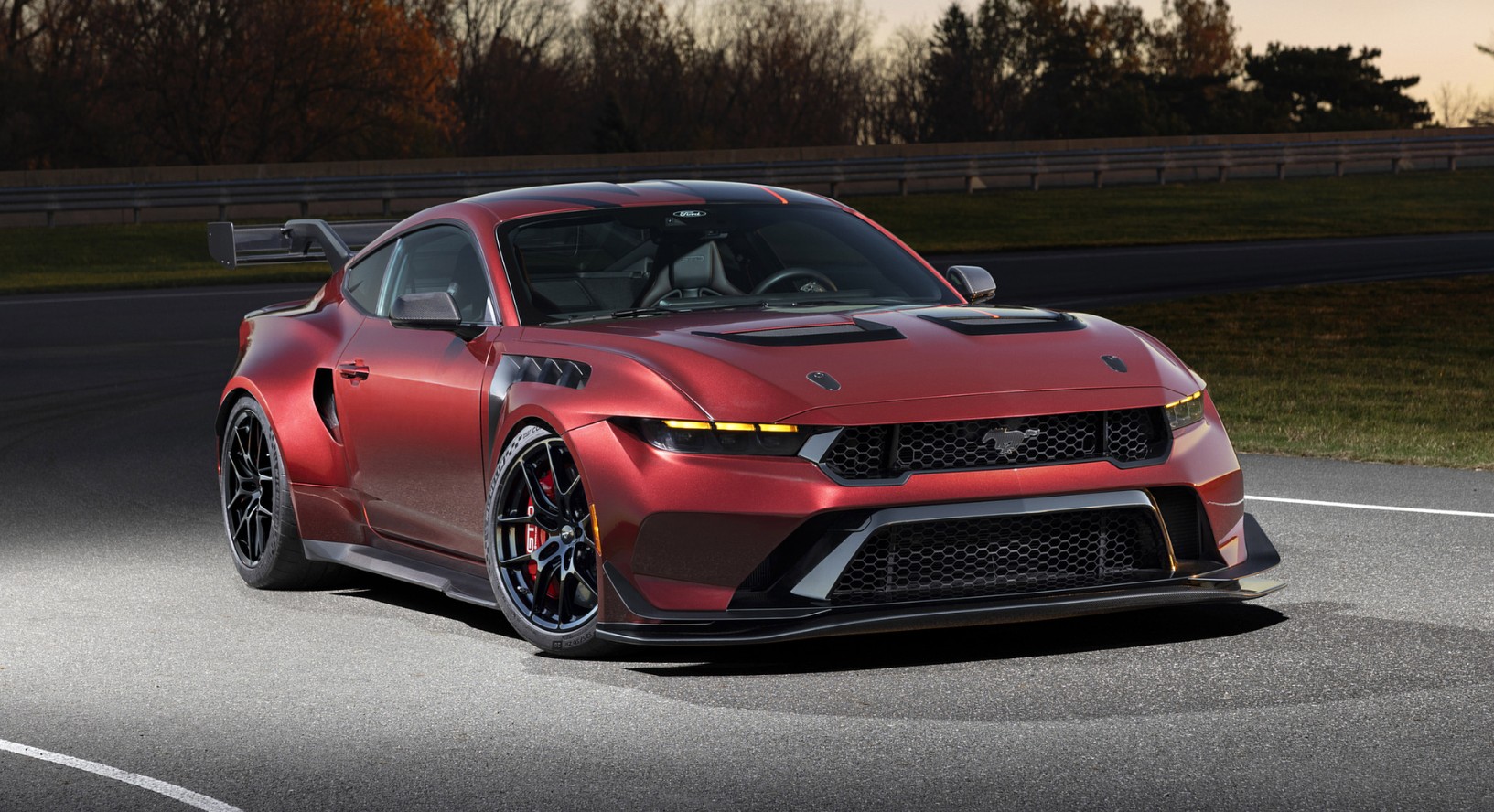
2027 Ford Mustang GTD 1901 Review, Specs, Interior – The 2027 Ford Mustang GTD 1901 is an extraordinary performance car that combines modern American engineering with one of the most important chapters in Ford’s early racing history. Officially introduced as a 2028 model-year special edition, the GTD 1901 is scheduled to reach customers beginning in the second quarter of 2027. Its name celebrates the year Henry Ford achieved his first major racing victory with the famous Sweepstakes racer, a machine that helped establish his reputation as an automotive engineer and competitor. More than a century later, Ford is using that historic achievement as inspiration for an exceptionally powerful, track-focused Mustang. With a supercharged 5.2-liter V8, 815 horsepower, extensive carbon-fiber components, and advanced aerodynamic technology, the GTD 1901 represents one of the most ambitious road-going Mustangs ever produced.
The Mustang GTD was developed to bring racing-inspired technology into a street-legal performance vehicle. Unlike an ordinary Mustang GT or Dark Horse, the GTD uses a highly specialized chassis, advanced suspension architecture, and a rear-mounted transaxle arrangement designed to improve weight distribution. Its engineering draws inspiration from Ford’s Mustang GT3 racing program, although the road car is developed to meet the requirements of public-road use. The 1901 edition builds on this already exceptional foundation rather than introducing an entirely different mechanical package. Its main distinction is a unique appearance, exclusive interior treatment, and additional equipment that connects the car to the story of Henry Ford’s first racing success.
The historical inspiration is particularly meaningful because the original Sweepstakes racer helped demonstrate Ford’s engineering ability at a time when the American automobile industry was still developing. Henry Ford drove the two-cylinder machine to victory in a race near Detroit in October 1901, defeating a more established competitor and winning a $1,000 prize. That achievement brought Ford valuable public attention and helped strengthen the business opportunities that eventually contributed to the founding of Ford Motor Company in 1903. The GTD 1901 interprets this history through a modern performance vehicle, using a red-and-black exterior theme inspired by the original race car. Rather than reproducing the historic vehicle’s appearance literally, Ford has translated its colors and racing spirit into contemporary aerodynamic bodywork.
The new special edition also arrives at a time when the Mustang GTD has established itself as a serious competitor in the high-performance supercar category. Its Nürburgring Nordschleife achievement of 6 minutes and 52.072 seconds demonstrated that an American production vehicle could deliver exceptional performance on one of the world’s most demanding circuits. The GTD combines extreme engine output with sophisticated suspension, aerodynamic development, and lightweight materials. The 1901 edition retains the core engineering that made the GTD famous while giving collectors a more historically significant version. For enthusiasts, it represents more than a cosmetic package: it connects Ford’s earliest racing ambitions with a modern Mustang developed to challenge established European performance machines. 2027 Ford Mustang GTD 1901 Review
2027 Ford Mustang GTD 1901 Redesign and Update Plan
Exterior & Interior
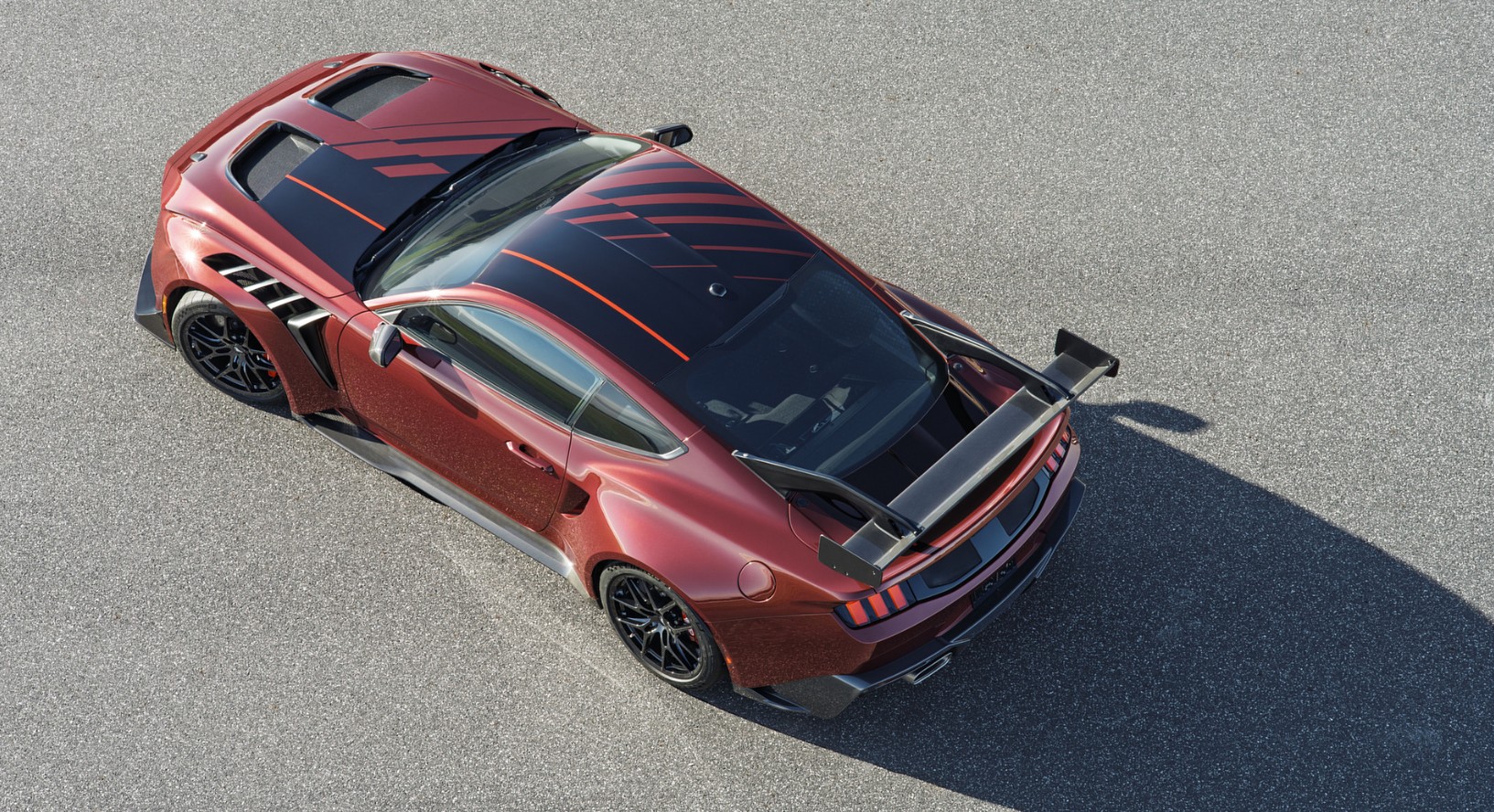
The most noticeable change to the 2028-model-year Mustang GTD 1901 is its exclusive Royal Red exterior finish. Ford selected this deep red color to reinterpret the red frame and mechanical details of Henry Ford’s original Sweepstakes racer. A broad black off-center racing stripe runs across the body, complemented by a narrow bright-red centerline and additional diagonal graphics. The result creates a strong visual identity without changing the GTD’s recognizable proportions. The front end retains its aggressive aerodynamic treatment, including a low splitter, large air openings, and sculpted surfaces designed to manage airflow. Instead of introducing a completely new body design, Ford has used the 1901 edition to give its existing performance platform a distinctive historical personality.
Carbon fiber remains central to the Mustang GTD’s exterior construction. The front splitter, lower side elements, rear diffuser, and large rear wing use exposed carbon-fiber detailing that emphasizes the car’s motorsport-inspired character. These components are not merely decorative additions. They form part of the aerodynamic package designed to manage airflow, increase stability, and generate downforce at high speeds. The GTD also uses active aerodynamic technology, allowing selected aerodynamic elements to adjust according to driving conditions. This combination of fixed and active components helps balance straight-line speed with cornering stability. The 1901 edition retains the GTD’s performance-oriented aerodynamic package, making its special paintwork and graphics an additional layer of exclusivity rather than a replacement for functional engineering.
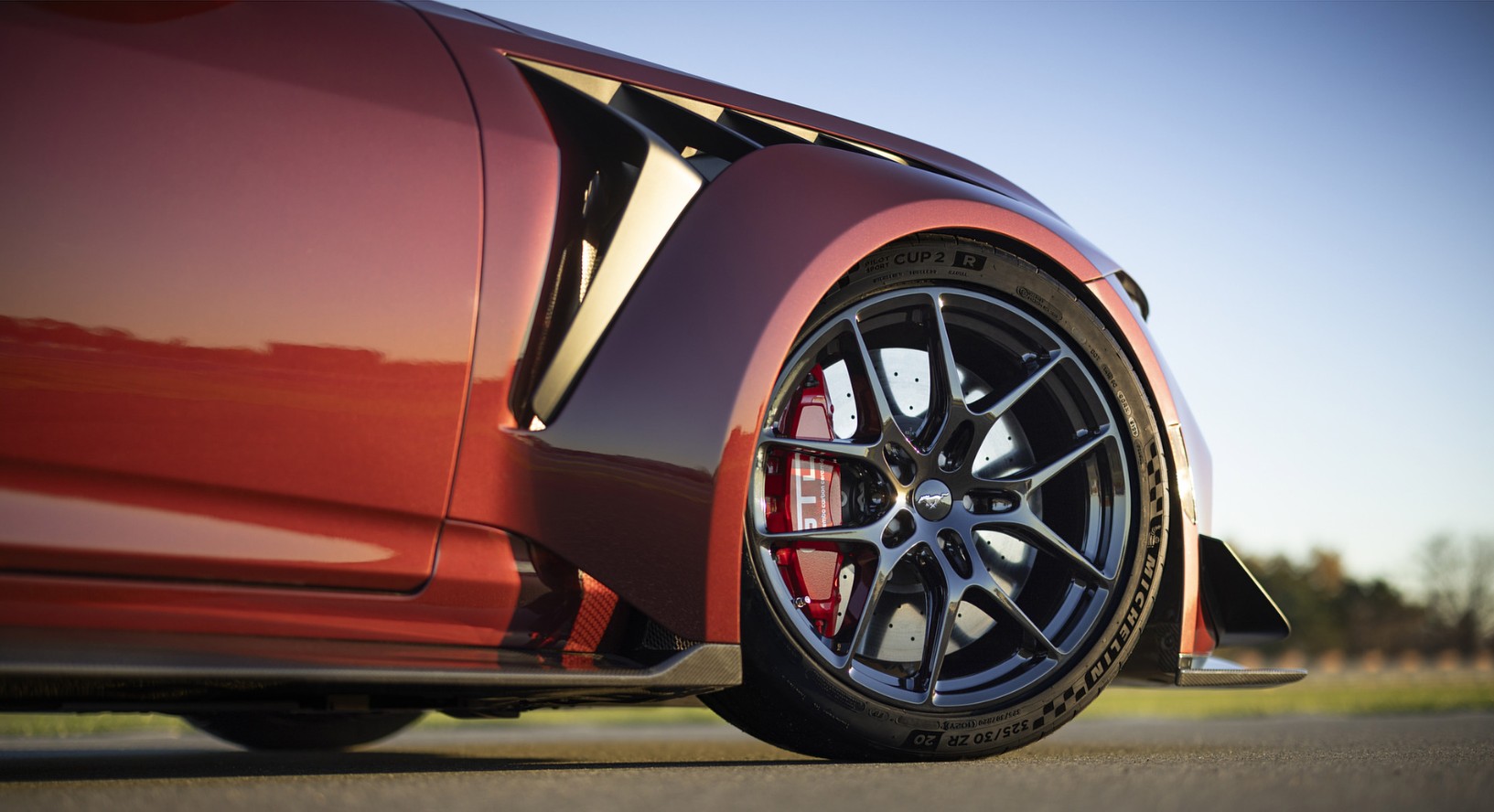
One important 2028 model-year development is the availability of optional lightweight magnesium wheels. According to Ford’s published information, the magnesium wheel setup reduces weight by approximately 50.3 pounds compared with the conventional wheel arrangement. Reducing unsprung and rotating mass can benefit suspension response, acceleration, braking, and overall vehicle dynamics. This is particularly valuable in a car designed to operate at high speeds and withstand repeated track use. The wheels complement the GTD’s extensive lightweight construction, which includes carbon-fiber body panels and other carefully engineered components. Ford has also introduced additional visual choices for the wider GTD range, including new paint and stripe combinations. The exact appearance will depend on the selected configuration and available options.
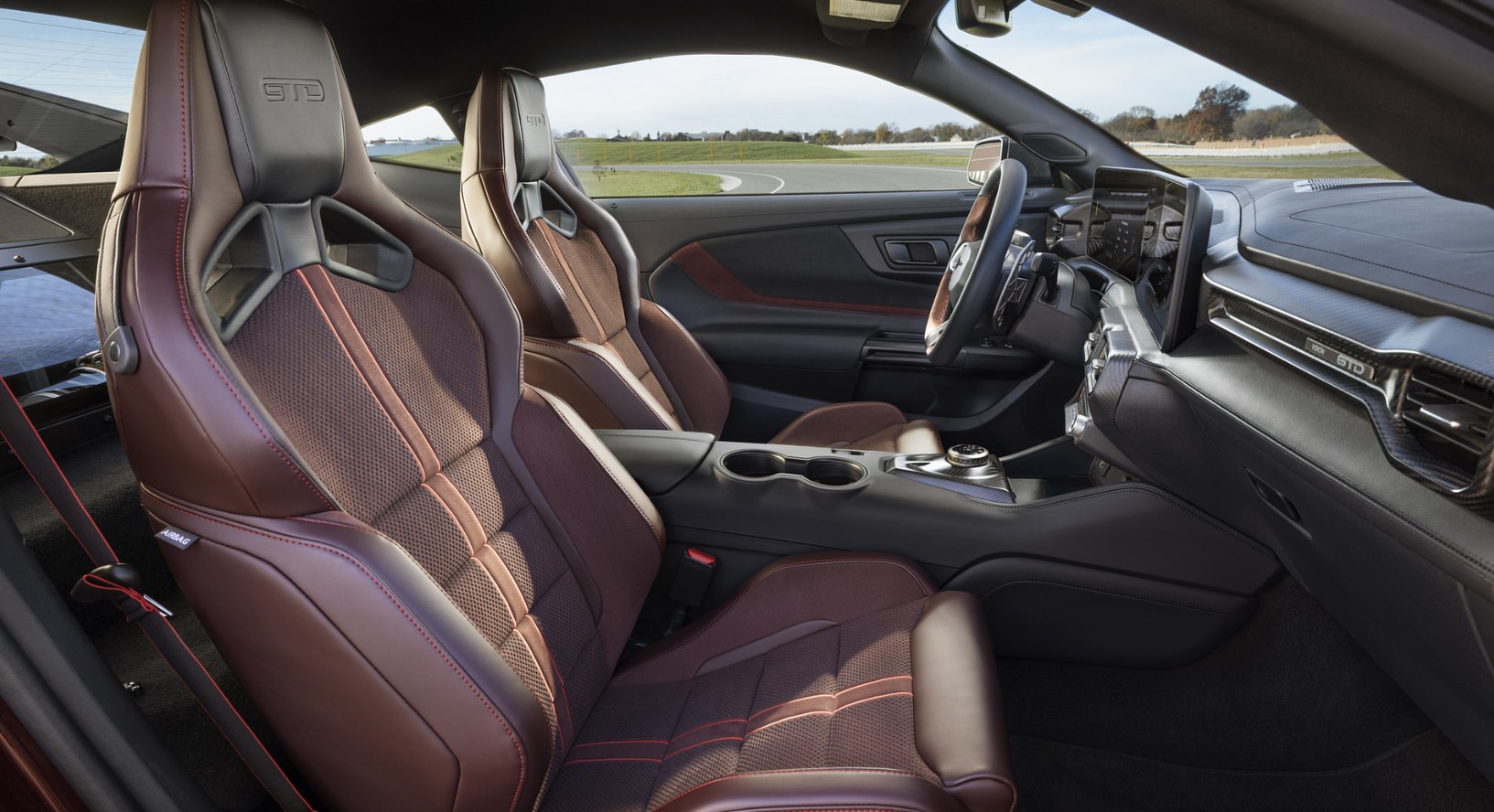
The interior of the GTD 1901 receives a distinctive treatment that separates it from other versions. The seats are upholstered in deep Mahogany Red leather with contrasting Race Red stitching, creating a cabin appearance that matches the exterior color scheme. Race Red detailing also appears along the seat-belt edges, while Mahogany Red suede is used on the inner section of the steering wheel. For the 2028 model year, Ford is also expanding the use of full-grain leather across areas such as the dashboard, door panels, and center console. The result is a more carefully finished interior that combines premium materials with the functional layout of a track-focused performance car. The GTD remains a two-seat vehicle, prioritizing driver and passenger accommodation over conventional Mustang rear-seat practicality.
2027 Ford Mustang GTD 1901 Specs
Engine & Performance
The heart of the Mustang GTD 1901 is Ford’s supercharged 5.2-liter Predator V8 engine. This high-performance powerplant produces an impressive 815 horsepower at 7,400 rpm and 664 lb-ft of torque at 4,800 rpm in the published specification. Its supercharger delivers substantial airflow to the engine, allowing it to produce exceptional power across a wide operating range. The engine’s character is central to the GTD experience, combining the immediate response expected from a high-performance V8 with the strong acceleration needed for circuit driving. Unlike hybrid performance cars that depend on electric assistance, the GTD delivers its power through a traditional combustion engine, making its exhaust sound and mechanical character a major part of its appeal.
Power is delivered through an eight-speed dual-clutch transmission connected to a rear-mounted transaxle. This layout is a defining feature of the GTD’s engineering because it helps distribute mechanical components more evenly across the vehicle. By positioning the transmission at the rear, Ford can achieve a more balanced front-to-rear weight distribution than a conventional front-engine Mustang with a transmission mounted directly behind the engine. The dual-clutch system is designed for rapid gear changes, supporting strong acceleration and consistent performance during demanding driving. Rear-wheel drive gives the GTD the traditional performance-car layout, while electronic systems help manage the substantial power available at the rear tires. This combination makes the GTD a highly specialized machine that demands respect from its driver.
The GTD’s performance is not based on engine output alone. Its suspension architecture uses race-derived technology, including an advanced rear setup with inboard springs and dampers. This arrangement allows engineers to manage suspension movement while creating space for the vehicle’s aerodynamic and mechanical components. Adaptive dampers help the car respond to different road and track conditions, while the ride-height adjustment system can lower the vehicle by approximately 40 millimeters when the appropriate track setting is selected. The sophisticated suspension geometry is designed to maintain tire contact with the road, control body movement, and provide stability through demanding corners. These characteristics are essential for a vehicle expected to deliver serious circuit performance while remaining road legal.
Aerodynamics and braking are equally important to the GTD’s performance. The extensive carbon-fiber bodywork helps reduce weight, while the active aerodynamic components are designed to improve high-speed stability and cornering performance. The car also uses Brembo carbon-ceramic braking technology to manage the enormous energy generated during repeated high-speed stops. These brakes offer strong heat resistance and are particularly appropriate for track use, where conventional braking systems can experience substantial thermal stress. Ford lists a top speed of 202 mph, equivalent to approximately 325 km/h. Its Nürburgring performance further demonstrates the effectiveness of the overall engineering package. Although the 1901 edition does not introduce a higher-output engine, it inherits the same exceptional mechanical foundation as the wider Mustang GTD family.
2027 Ford Mustang GTD 1901 Fuel Economy
Fuel economy is not the primary reason to purchase the Mustang GTD 1901, but its consumption remains relevant to ownership costs and environmental regulations. The supercharged 5.2-liter V8 is engineered to deliver enormous performance, and that level of output requires substantial fuel. European homologation information published by Ford lists combined fuel consumption at approximately 15.3 liters per 100 kilometers under the applicable WLTP procedure. This figure is a laboratory-based testing result and should not be treated as a guaranteed real-world average. Actual consumption can rise considerably during aggressive acceleration, high-speed driving, or repeated track sessions. For American-market reference, published estimates for the wider GTD range are approximately 10 mpg city, 17 mpg highway, and 12 mpg combined, although ratings can vary by model-year certification.
Owners should also consider the additional operating costs associated with an extreme performance vehicle. Premium fuel, high-performance tires, specialized brake components, and track-oriented maintenance can make the GTD considerably more expensive to operate than an ordinary Mustang. Carbon-ceramic brakes can offer excellent performance and durability under appropriate conditions, but replacement and servicing costs are substantial. The car’s supercharged V8 also produces considerable heat during demanding operation, making correct maintenance and cooling-system care especially important. For buyers who intend to use the GTD on a circuit, budgeting for tires, brake inspections, fluid changes, and professional maintenance is essential. Its efficiency figures are therefore best understood as technical reference points rather than a meaningful measure of economical everyday transportation.
2027 Ford Mustang GTD 1901 Safety Features
The Mustang GTD 1901 approaches safety from the perspective of an extremely powerful performance vehicle. Its advanced chassis, braking system, aerodynamic components, and tire package are designed to help the driver maintain control during demanding acceleration, cornering, and braking. The Brembo carbon-ceramic brakes are especially important because the vehicle can reach very high speeds and generate substantial braking temperatures during track sessions. The suspension system works with the tires to maintain contact with the road, while electronic stability and traction-control systems help manage vehicle movement when grip becomes limited. These systems do not eliminate the risks associated with extreme performance, but they provide essential support for a car capable of delivering more than 800 horsepower.
The GTD’s safety equipment also includes the fundamental protective systems expected in a modern road-going vehicle. Its structural design, seat-belt systems, airbags, and driver-positioning components are intended to protect occupants while supporting the car’s high-performance mission. The two-seat cockpit uses specialized Recaro seating designed to provide better support during aggressive cornering than ordinary passenger-car seats. A low driving position helps the driver remain connected to the vehicle, while the steering wheel and instrument displays are arranged to make important information accessible. The GTD’s digital cockpit includes a 12.4-inch instrument cluster and a 13.2-inch central display, giving the driver access to vehicle information, entertainment, and configurable performance-related graphics.
Driver assistance technology should be considered in the context of the GTD’s intended purpose. Unlike a conventional family SUV, this vehicle places much greater emphasis on chassis control, braking performance, and driver involvement. Buyers should not assume that it offers the same comprehensive assistance package found in more comfort-oriented Ford models. Equipment such as parking assistance, camera systems, collision-warning functions, and other electronic features can vary according to the final market specification. The car’s extensive performance hardware is not a substitute for responsible driving, particularly when operating at high speeds. Drivers should use appropriate safety equipment and reserve maximum-performance operation for suitable closed-course environments rather than attempting to explore the vehicle’s limits on public roads. 2027 Ford Mustang GTD 1901 Review
2027 Ford Mustang GTD 1901 Release Date & Price
The Mustang GTD 1901 is not a conventional trim level in the same sense as the Mustang EcoBoost, GT, or Dark Horse. It is a special edition within Ford’s limited-production GTD program, using the same high-performance mechanical package while introducing exclusive styling and interior details. For the 2028 model year, Ford is positioning the 1901 as a tribute edition inspired by the company’s earliest racing history. The Royal Red paint, black racing graphics, Mahogany Red leather, and Race Red stitching are among its most recognizable features. The special edition is expected to represent approximately 20 percent of the 2028 GTD production allocation, according to published reporting. This limited positioning makes it particularly attractive to collectors who value the historical connection as well as the vehicle’s performance.
The wider 2028 Mustang GTD range provides additional configuration choices for buyers who do not necessarily want the 1901 appearance package. Ford has announced updates that include new paint choices, optional magnesium wheels, and revised interior equipment. The Liquid Carbon configuration also receives additional visual details, while selected titanium components are available through an optional trim package. The titanium parts include redesigned paddle shifters and a revised rotary gear selector. Ford uses 3D-printed titanium material sourced from retired Lockheed Martin F-22 fighter jet components for these optional interior details. This unusual connection between automotive engineering and aerospace materials reinforces the GTD’s exclusive character. Buyers should confirm the final configuration and option availability directly with Ford because production allocations and specifications are limited.
Ford has not officially announced the final retail price of the 2028 Mustang GTD 1901. The wider Mustang GTD family has carried a starting price well above $300,000 in the United States, while special packages and exclusive configurations can command substantially higher amounts. The 1901 edition is expected to occupy the upper end of this already expensive range, but any specific price prediction should be treated as an estimate until Ford publishes the official figure. Its limited production, specialized components, carbon-fiber construction, and bespoke interior details are likely to make it a particularly expensive purchase. Prospective buyers should also account for taxes, registration, insurance, shipping, and any market-specific charges that apply to an imported performance car.
The ordering and delivery schedule is more clearly defined than the final price. Ford has indicated that order books for the 2028 model-year Mustang GTD are expected to open in December 2026, with deliveries beginning in the second quarter of 2027. This explains why the vehicle may be discussed as a 2027 arrival even though its official designation is the 2028 model year. Production is expected to remain highly limited, and Ford has indicated that demand exceeds the number of cars it can build. The exact allocation available to individual markets and the number of 1901 examples will depend on Ford’s production plans. Buyers interested in securing one should follow Ford’s official application and ordering process rather than assuming that ordinary dealership ordering will be available.
The 2027 Ford Mustang GTD 1901 is ultimately a remarkable expression of Ford’s racing identity. Its 815-horsepower supercharged V8, rear-mounted dual-clutch transaxle, advanced suspension, carbon-fiber bodywork, active aerodynamics, and carbon-ceramic brakes create a performance package far beyond an ordinary Mustang. The 1901 edition adds a historical dimension through its Royal Red exterior, black racing graphics, and carefully finished Mahogany Red interior. It is expensive, rare, and highly specialized, with limited practicality compared with ordinary road cars. However, those compromises are part of its purpose. For collectors and performance enthusiasts, the GTD 1901 offers an unusual combination of modern supercar engineering and a direct tribute to the racing achievement that helped establish Henry Ford’s name.
Conclusion
The Ford Mustang GTD 1901 connects more than a century of racing history with one of the most advanced road-going Mustangs ever developed. Its special-edition styling celebrates Henry Ford’s 1901 Sweepstakes victory, while its 815-horsepower supercharged V8 and race-derived chassis deliver genuinely exceptional performance. The exclusive interior, carbon-fiber aerodynamic components, optional magnesium wheels, and advanced braking system make it a distinctive addition to the GTD family. Although its price and exact production allocation remain limited and subject to Ford’s final announcements, the 1901 edition stands out as a collector-focused performance machine. With deliveries expected in 2027, it brings Ford’s historic racing spirit into a new generation of American supercar engineering.
Note: The details included in this blog post are derived from pre-release material that was accessible when the article was written. If you want the latest information, you should check official sources or call your nearest dealership.
Frequently Asked Questions
2027 Ford Mustang GTD 1901 Review, Specs, Interior - The 2027 Ford Mustang GTD 1901 is an extraordinary performance car that combines modern American engineering with one of the most important chapters in Ford's early racing history. Officially introduced as a 2028 model-year special edition, the GTD 1901…
The Mustang GTD was developed to bring racing-inspired technology into a street-legal performance vehicle. Unlike an ordinary Mustang GT or Dark Horse, the GTD uses a highly specialized chassis, advanced suspension architecture, and a rear-mounted transaxle arrangement designed to improve weight distribution. Its engineering draws inspiration from Ford's…
The historical inspiration is particularly meaningful because the original Sweepstakes racer helped demonstrate Ford's engineering ability at a time when the American automobile industry was still developing. Henry Ford drove the two-cylinder machine to victory in a race near Detroit in October 1901, defeating a more established competitor…
The new special edition also arrives at a time when the Mustang GTD has established itself as a serious competitor in the high-performance supercar category. Its Nürburgring Nordschleife achievement of 6 minutes and 52.072 seconds demonstrated that an American production vehicle could deliver exceptional performance on one of…
2027 Ford Mustang GTD 1901 Redesign and Update Plan Exterior & Interior The most noticeable change to the 2028-model-year Mustang GTD 1901 is its exclusive Royal Red exterior finish. Ford selected this deep red color to reinterpret the red frame and mechanical details of Henry Ford's original Sweepstakes…