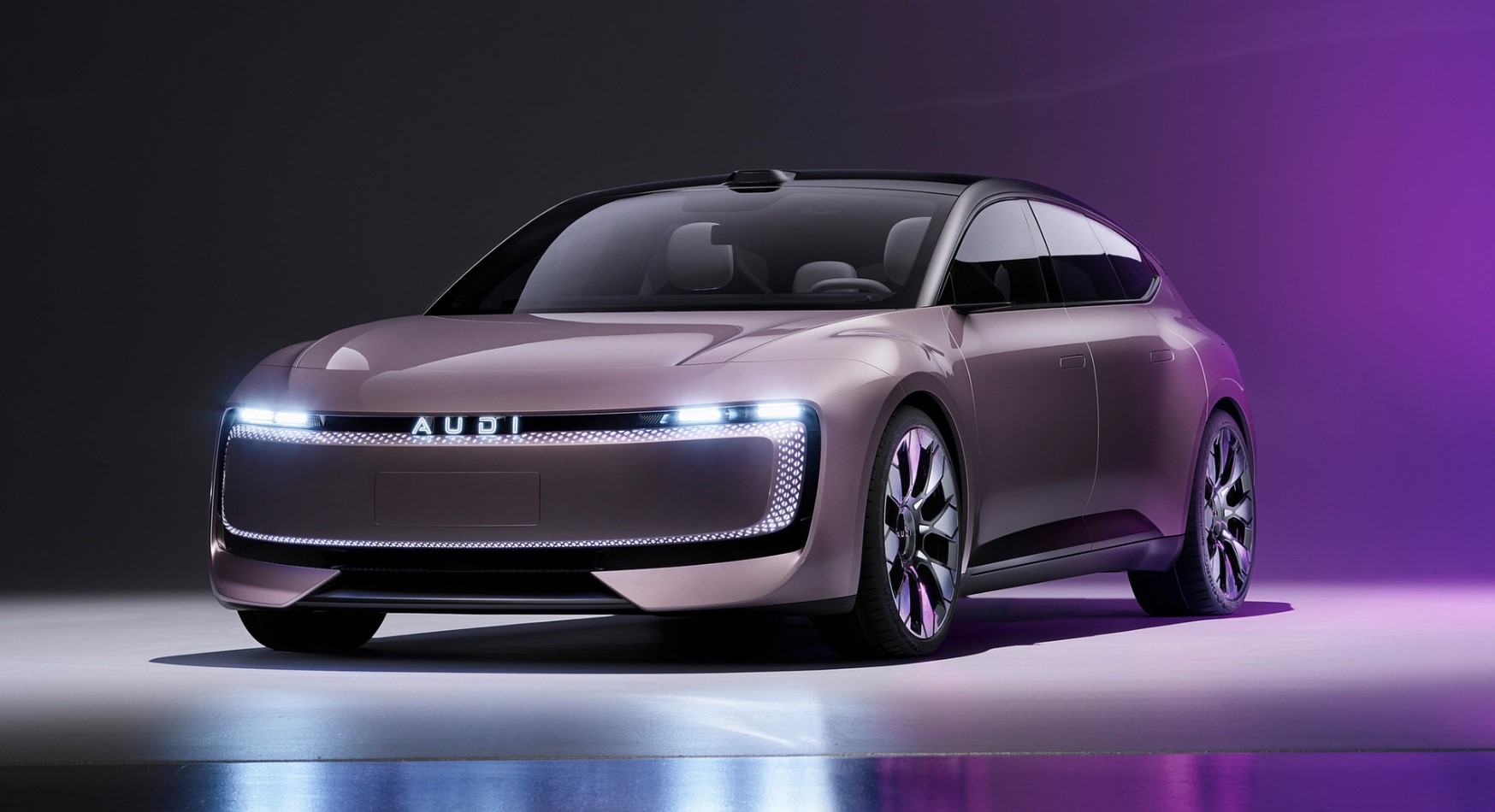
2027 Audi E Concept Review, Performance, Features – The 2027 Audi E Concept is shaping up to be one of the more interesting names associated with Audi’s rapidly expanding electric-car strategy, but there is an important distinction to make at the outset: the AUDI E concept officially unveiled in Shanghai is a concept vehicle created for Audi’s China-specific AUDI brand, not a confirmed global-production model carrying a 2027 Audi E badge.
Audi introduced the concept in November 2024 as a fully electric Sportback developed with SAIC and built around the Advanced Digitized Platform. Its published numbers are striking: two electric motors, 570 kW of combined output, 800 Nm of torque, a 100-kWh battery and a claimed 700 km of CLTC range. Audi also quoted 0–100 km/h acceleration in 3.6 seconds.
That makes the E concept particularly important when discussing Audi’s 2027 electric future. Rather than treating the concept as a conventional upcoming trim with an already confirmed U.S. MSRP, it is more accurate to view it as a technology and design statement that helped establish Audi and SAIC’s China-focused electric model family. The production AUDI E5 Sportback subsequently arrived in 2025, using the same Advanced Digitized Platform philosophy, while the later E SUV concept evolved into the production AUDI E7X. This means the E concept has already demonstrated that its ideas were intended for real production vehicles rather than being purely an exhibition exercise.
For buyers searching specifically for a “2027 Audi E Concept,” expectations therefore need to be separated between confirmed information and forward-looking possibilities. Audi has not published an official 2027 production price, trim structure, EPA fuel-economy rating or global release schedule for a vehicle simply called the Audi E Concept. The concept itself was engineered for China and positioned as a preview of three future production models. Its significance comes from the combination of Audi design, SAIC technology, an 800-volt electrical architecture and an interface philosophy created specifically for highly connected Chinese customers.
The concept nevertheless deserves serious attention because it shows how quickly Audi is changing its approach to electric vehicles. Its smooth Sportback body avoids the overly complicated styling seen on some futuristic EVs, while the cabin focuses heavily on digital interaction and passenger comfort. Audi described the project as a combination of German engineering DNA and Chinese innovation, with the Advanced Digitized Platform cutting development time by more than 30 percent. If the ideas represented by the E concept continue influencing Audi’s electric portfolio through 2027 and beyond, this vehicle could become an important reference point for understanding the brand’s next generation of premium EVs. 2027 Audi E Concept Review
2027 Audi E Concept Redesign and Update Plan
Exterior & Interior
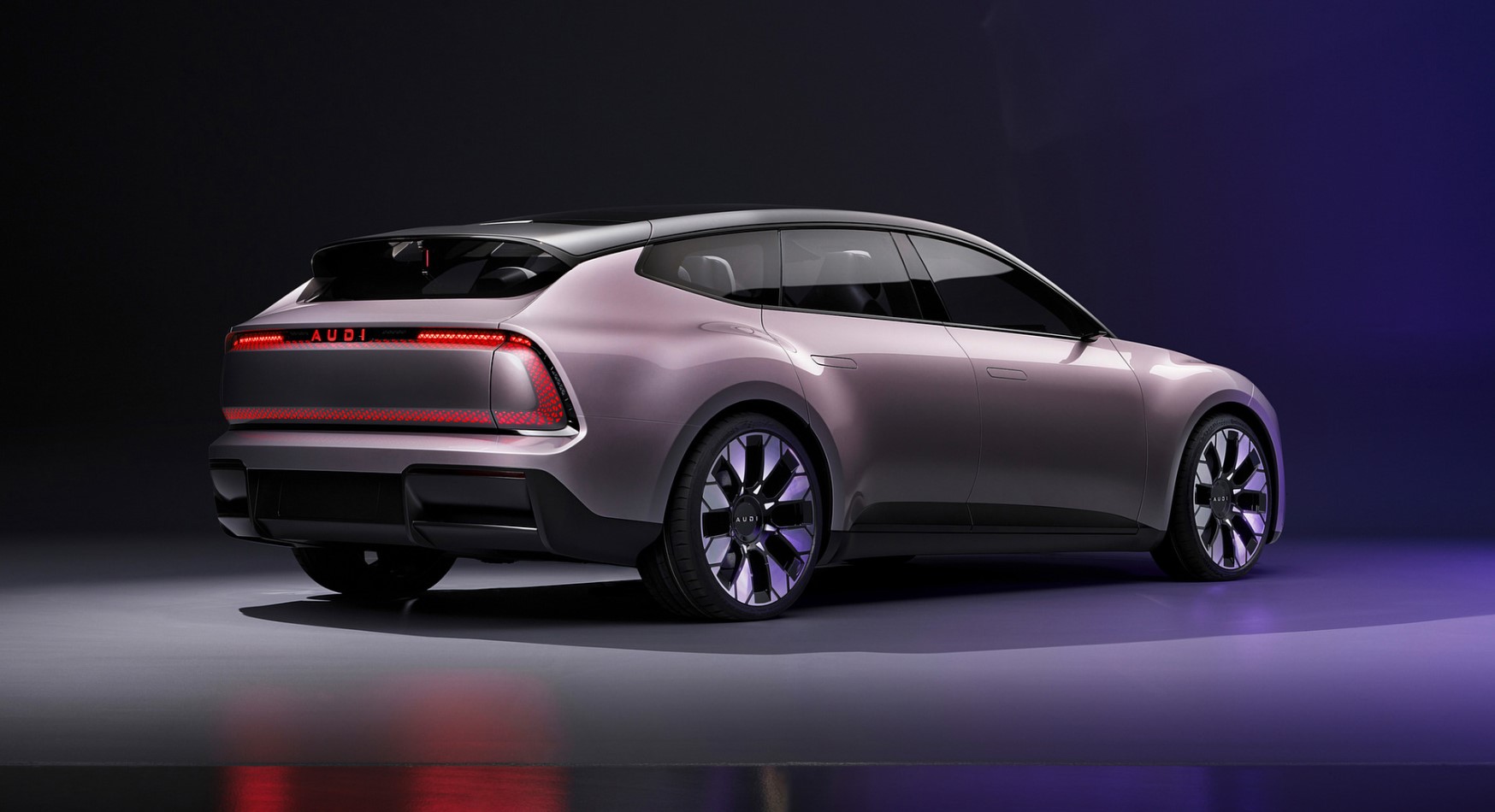
The exterior of the Audi E concept is defined by a Sportback silhouette that combines a long, low roof with the practical proportions expected from a four-door premium EV. Audi deliberately avoided excessive surface decoration. The body uses smooth wheel arches, a relatively clean shoulder line and wrap-around lighting graphics to create a modern appearance without relying on traditional grille openings. The result is futuristic but recognizable as an Audi-related product, especially through its proportions, lighting treatment and emphasis on precise geometry. Audi positioned the concept as a vehicle that could satisfy Chinese customers looking for both premium status and advanced technology.
One of the most distinctive exterior elements is the black wraparound loop at the front and rear. Instead of separating the grille, lamps, sensors and aerodynamic components into numerous visual elements, the design integrates these functions into a central architectural feature. This creates a broad, horizontal visual signature at the front while allowing the headlights and sensors to become part of the same design structure. Audi’s approach is deliberately different from conventional combustion-powered vehicles because an electric car does not require a large cooling grille. The E concept uses that freedom to create a cleaner face with a stronger technological identity.
The proportions also contribute directly to the car’s aerodynamic character. With a length of 4,870 mm and a wheelbase of 2,950 mm, the E concept has enough space to create a substantial passenger compartment without adopting the upright shape of an SUV. The 1,460-mm overall height keeps the roofline relatively low, while the broad 1,990-mm body gives the concept a planted stance. The smooth bodywork and flush-looking surfaces reinforce the impression of a vehicle designed around aerodynamic efficiency rather than decorative complexity.
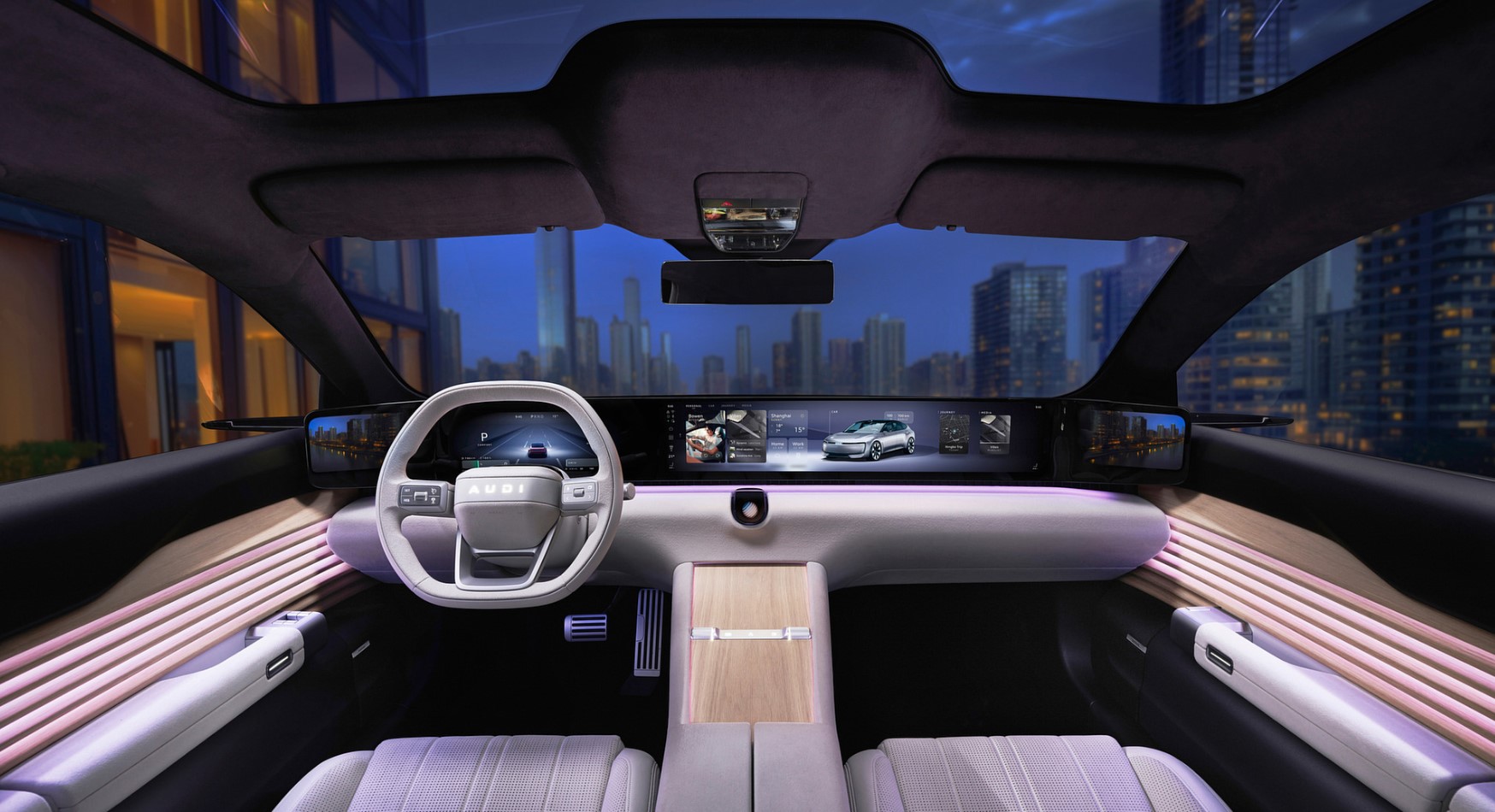
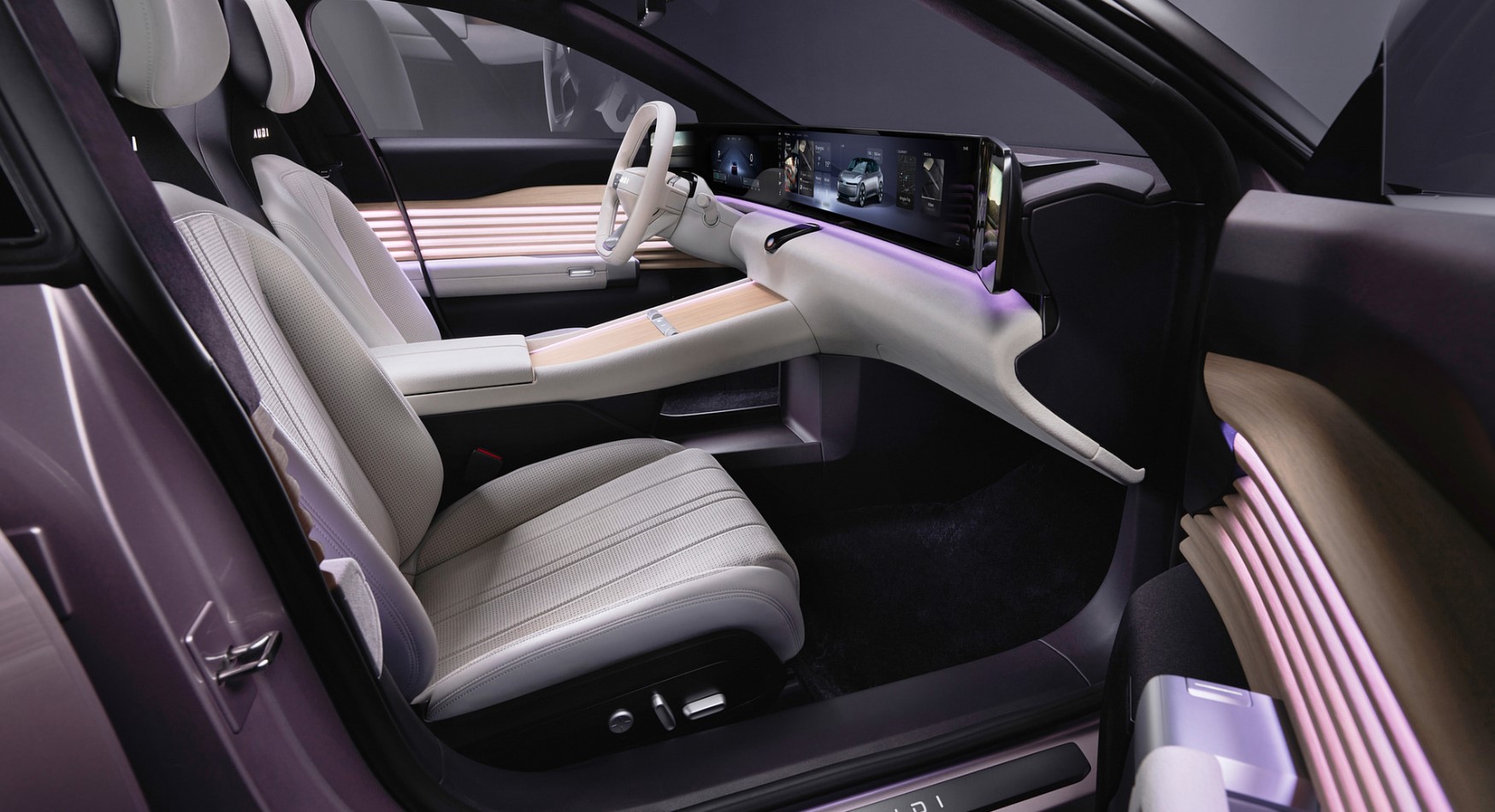
Inside, Audi takes an entirely different approach from the cluttered dashboard layouts found in some high-tech EVs. The concept features a curved, pillar-to-pillar 4K touchscreen display, with the digital exterior-mirror feeds integrated into the screen architecture. Open storage for two smartphones is incorporated into the center console, while illuminated wood and microfiber door treatments add warmth to an otherwise highly digital cabin. Audi’s goal was to create a connected environment that still felt comfortable and sophisticated rather than turning the interior into a laboratory filled with screens.
The cabin also introduces Audi’s AUDI OS, an operating-system concept designed around personalized digital interaction. This system reflects the China-specific development philosophy behind the vehicle, where smartphone integration, connected services, intelligent assistance and rapid software development are central to the ownership experience. Rather than simply installing a large screen, Audi and SAIC developed the vehicle around a broader digital ecosystem. The concept therefore represents an important shift from viewing software as an accessory to treating it as a fundamental part of the car’s architecture.
The redesign story surrounding the 2027 Audi E Concept is unusual because there is no conventional model-year redesign plan to follow. The AUDI E concept itself was already a design and technology preview rather than a production vehicle. Audi presented it as the benchmark for a new generation of intelligent, connected electric cars developed specifically for China. Its dimensions measure 4,870 mm long, 1,990 mm wide and 1,460 mm high, with a 2,950-mm wheelbase. Those proportions place the concept firmly in the premium Sportback category, giving it a long, low silhouette while preserving a relatively generous passenger compartment.
The most important update path has already appeared through the production models derived from the broader AUDI strategy. The E5 Sportback became the first production model from the new China-exclusive AUDI brand in 2025. Audi describes it as a fully electric fastback with up to 579 kW of output, a maximum claimed range of 770 km and four powertrain configurations, including rear-wheel drive and quattro. Its relationship to the E concept demonstrates how the original concept’s priorities—fastback proportions, high-output electric propulsion, sophisticated connectivity and rapid charging—can be translated into a production vehicle.
The next major step is the AUDI E7X, which follows the E SUV concept presented in 2025. Audi says the E7X carries the expressive design language of the concept into series production and offers two powertrain variants with 300 kW and 500 kW outputs. Its production dimensions remain close to the concept, demonstrating that Audi and SAIC are not abandoning the styling language once a show car becomes a production program. This is particularly relevant to the 2027 outlook because the E concept should be considered part of a growing family of vehicles rather than an isolated prototype.
For 2027, the most realistic expectation is therefore continued development of this China-specific electric architecture rather than a traditional “2027 E Concept facelift.” Audi’s strategy combines an established premium brand identity with a faster development process and China-specific software and connectivity. The company has not announced a conventional trim-by-trim 2027 E Concept lineup. Any claim that a specific Premium, Premium Plus or Prestige trim will be offered would be speculation. The confirmed story is much more interesting: the original E concept established the architecture and design direction, and subsequent production models have begun putting those ideas onto Chinese roads. 2027 Audi E Concept Review
2027 Audi E Concept Specs
Engine & Performance
The powertrain is arguably the most impressive confirmed aspect of the Audi E concept. Audi fitted the vehicle with two electric motors, one mounted on each axle, producing a combined 570 kW and 800 Nm of torque. The arrangement provides electric all-wheel drive through Audi’s quattro system and gives the concept the ability to deliver extremely rapid acceleration. Audi quotes a 0–100 km/h time of 3.6 seconds, placing the E concept firmly within high-performance luxury EV territory rather than the ordinary premium commuter category.
Unlike many concept cars whose performance figures are little more than theoretical targets, the E concept was developed around a genuine vehicle architecture. Audi emphasized that the car combines comfort with dynamic driving behavior and retains the brand’s quattro philosophy. Instant electric torque gives the car a fundamentally different response from a turbocharged combustion engine. There is no traditional gearshift interruption or need to build boost before maximum torque arrives. A production interpretation of this powertrain philosophy could deliver strong launch performance while also providing precise traction management on wet or slippery surfaces.
The Advanced Digitized Platform is equally important. Audi and SAIC developed the architecture specifically for intelligent connected electric vehicles, allowing hardware and software to be developed together rather than adapting an older combustion-oriented platform. The E concept uses an 800-volt electrical architecture, a key factor in its charging performance. Audi states that ten minutes of rapid charging can add more than 370 km of CLTC range under the concept’s specified conditions. That kind of charging capability is essential for premium EVs because customers increasingly judge electric vehicles not only by battery size but also by how quickly long-distance travel can resume.
The 100-kWh battery is particularly significant because it gives the E concept a substantial energy reserve while supporting its performance-focused dual-motor setup. Audi quotes up to 700 km of CLTC range, but CLTC is a Chinese testing standard and should not be directly converted into an EPA range figure. A future production model could have a different battery capacity, motor calibration, curb weight and official range rating. For that reason, it would be inaccurate to publish a specific 2027 EPA range until Audi officially announces a production version for the relevant market.
2027 Audi E Concept Fuel Economy
Because the Audi E concept is a battery-electric vehicle, conventional mpg figures do not apply. Energy consumption is instead measured in kWh, and the concept’s headline figure is its 100-kWh battery combined with a claimed 700 km CLTC range. That suggests an approximate theoretical consumption level of 14.3 kWh per 100 km if the full battery capacity and claimed range are used as a simple calculation, although this should not be treated as an official certified consumption figure. Real-world efficiency would vary with speed, temperature, road conditions, wheel configuration, climate-control use and driving style.
The concept’s 800-volt system is arguably more important to everyday usability than the headline range number. Audi claims that ten minutes of rapid charging can provide more than 370 km of additional CLTC range. That gives the vehicle a theoretical charging rate that can dramatically reduce the time spent at high-power charging stations. The exact charging performance of a future production vehicle would depend on the charger, battery temperature, state of charge and final battery chemistry. Nevertheless, the concept clearly establishes fast charging as a central requirement of Audi’s China-focused EV strategy.
The E concept also demonstrates why electric efficiency cannot be judged by battery size alone. A 100-kWh battery provides substantial range potential, but a large battery adds weight. Audi therefore has to balance battery capacity, aerodynamic efficiency, motor efficiency, thermal management and vehicle mass. The Sportback body helps by presenting a relatively low roofline and smooth surfaces, while dual-motor quattro provides performance and traction at the cost of additional hardware. The eventual production vehicle would need to optimize those competing priorities to deliver a useful combination of range, acceleration and charging speed.
For international buyers searching for 2027 Audi E Concept fuel economy information, the safest conclusion is that no official EPA or WLTP figure exists for the concept. The 700-km figure is specifically a CLTC claim supplied by Audi for the concept vehicle. It should not be marketed as a guaranteed real-world range. If Audi eventually develops a production vehicle based directly on the concept, official regional certification will provide a more meaningful comparison with other premium EVs. Until then, the 100-kWh battery, 700-km CLTC claim and 800-volt charging system are the confirmed reference points. 2027 Audi E Concept Review
2027 Audi E Concept Safety Features
The safety strategy behind the E concept goes beyond conventional airbags, stability control and crash protection. Audi specifically highlighted China-oriented driver-assistance functions designed for highway travel, dense urban traffic and automated parking. The concept therefore serves as a showcase for how sensor technology, computing power and connected services can work together. The objective is to make the vehicle less demanding to operate in congested environments while maintaining Audi’s focus on dynamic driving. Exact production safety specifications, however, remain unavailable because the concept was not sold as a conventional consumer model.
Automated parking is one of the technologies Audi specifically highlighted. In a market dominated by dense urban environments and increasingly sophisticated digital services, parking assistance can provide substantial everyday value. The concept also demonstrates how Audi expects driver assistance to evolve beyond isolated features. Instead of treating adaptive cruise control, lane assistance, parking and navigation as separate systems, the vehicle’s digital architecture is designed to integrate them into a broader intelligent driving environment. A production version could therefore benefit from the same architecture while receiving market-specific regulatory and safety calibrations.
Connectivity is another major component of the E concept’s safety and convenience strategy. The AUDI OS operating system is intended to provide an interface between occupants and the vehicle’s digital ecosystem, while the Advanced Digitized Platform supports over-the-air software development and updates. This means future production models can potentially improve functionality after delivery instead of depending exclusively on physical dealership updates. Audi’s China-specific approach is particularly focused on customers who already expect smartphones, cloud services and intelligent assistants to work together seamlessly.
2027 Audi E Concept Release Date & Price
The absence of a price does not mean the concept lacks commercial relevance. Audi and SAIC have already demonstrated that the technology behind the concept can be transformed into production vehicles. The E5 Sportback became the first production model of the new AUDI brand in China, with up to 579 kW and a claimed maximum range of 770 km. That model entered the Chinese market in summer 2025, proving that the E concept’s underlying development program moved rapidly from design study to production.
The E SUV concept followed a similar path. Audi unveiled the large electric SUV concept at Auto Guangzhou in 2025 and later introduced the production E7X. The E7X measures 5,049 mm in length, 2,002 mm in width and 1,708 mm in height, with a 3,060-mm wheelbase. It carries the concept’s lighting and exterior design language into series production and offers 300-kW and 500-kW powertrain versions. This progression provides the strongest evidence that Audi’s concept vehicles are being used as genuine previews of production products rather than simply styling exercises.
For a supposed 2027 release date, there is therefore no official launch date for a production vehicle called the “2027 Audi E Concept.” The original E concept debuted in Shanghai in 2024, while related production vehicles have already entered the market. Audi’s broader electric strategy continues to expand, but a future production car should not be assigned the E Concept name, price or release date until Audi officially confirms those details. That distinction is especially important for anyone comparing the vehicle with the global Audi lineup because the AUDI brand created with SAIC is specifically positioned for China.
There are currently no confirmed 2027 Audi E Concept trim levels. The reason is straightforward: the E concept is not a conventional production model. Audi introduced it as the first concept vehicle for the China-specific AUDI brand and stated that it previewed three future production models. The first production model, the AUDI E5 Sportback, arrived in 2025, while the E SUV concept later evolved into the AUDI E7X. Consequently, publishing invented “Premium,” “Premium Plus” or “Prestige” grades for a 2027 E Concept would create specifications that Audi has not announced.
Conclusion
The 2027 Audi E Concept is best understood as a window into Audi’s China-focused electric strategy rather than a conventional upcoming model with finalized trims and pricing. Its 570-kW dual-motor system, 800 Nm of torque, 100-kWh battery, 700-km CLTC range and 800-volt architecture give the concept serious technical credibility. Its minimalist Sportback design, curved 4K display, digital mirror integration and AUDI OS demonstrate a broader change in how Audi approaches vehicle design and software.
More importantly, the concept has already influenced real production vehicles. The E5 Sportback brought the Advanced Digitized Platform into production, while the E SUV concept evolved into the E7X. For 2027 and beyond, those vehicles provide a more reliable picture of where the technology is heading than invented specifications for a nonexistent production trim. The E concept remains significant because it combines Audi’s performance and design heritage with SAIC’s China-focused digital and development expertise. It is not yet a $70,000 or $100,000 showroom model with a fixed release date, but its influence on Audi’s electric future is already visible.
Note: The details included in this blog post are derived from pre-release material that was accessible when the article was written. If you want the latest information, you should check official sources or call your nearest dealership.
Read Also:
- 2027 Audi Q8 Redesign, Price, Specs
- 2027 Audi A6 55 TFSI e quattro Release Date, Specs, Interior
- 2027 Audi S3 Redesign, Price, Configurations
- 2027 Audi RSQ8 Price, Dimensions, Release Date
- 2027 Audi S5 Redesign, Specs, Dimensions
Frequently Asked Questions
2027 Audi E Concept Review, Performance, Features - The 2027 Audi E Concept is shaping up to be one of the more interesting names associated with Audi’s rapidly expanding electric-car strategy, but there is an important distinction to make at the outset: the AUDI E concept officially unveiled…
Audi introduced the concept in November 2024 as a fully electric Sportback developed with SAIC and built around the Advanced Digitized Platform. Its published numbers are striking: two electric motors, 570 kW of combined output, 800 Nm of torque, a 100-kWh battery and a claimed 700 km of…
That makes the E concept particularly important when discussing Audi’s 2027 electric future. Rather than treating the concept as a conventional upcoming trim with an already confirmed U.S. MSRP, it is more accurate to view it as a technology and design statement that helped establish Audi and SAIC’s…
For buyers searching specifically for a “2027 Audi E Concept,” expectations therefore need to be separated between confirmed information and forward-looking possibilities. Audi has not published an official 2027 production price, trim structure, EPA fuel-economy rating or global release schedule for a vehicle simply called the Audi E…
The concept’s 800-volt system is arguably more important to everyday usability than the headline range number. Audi claims that ten minutes of rapid charging can provide more than 370 km of additional CLTC range. That gives the vehicle a theoretical charging rate that can dramatically reduce the time spent at high-power charging stations. The exact charging performance of a future production vehicle would depend on the charger, battery temperature, state of charge and final battery chemistry. Nevertheless, the concept clearly establishes fast charging as a central requirement of Audi’s China-focused EV strategy.