
2028 Aston Martin Valhalla Spider Redesign, Specs, Price – The 2028 Aston Martin Valhalla Spider brings a new dimension to one of the most ambitious supercars in the British manufacturer’s history. Officially unveiled on October 28, 2026, the Spider transforms the mid-engine Valhalla into an open-cockpit performance machine without sacrificing its extraordinary hybrid powertrain. It combines a bespoke 4.0-liter twin-turbocharged V8, three electric motors, advanced torque vectoring, and sophisticated active aerodynamics. With a total system output of 1,079 PS, equivalent to approximately 1,064 horsepower, the Valhalla Spider enters the exclusive territory of hypercar-level performance. Its headline figures include a claimed 0–62 mph acceleration time of 2.5 seconds and a maximum speed of 217 mph, even with the roof removed.
The Spider is more than a conventional convertible version of the Valhalla Coupe. Aston Martin has reworked the vehicle’s aerodynamic management, airflow systems, electronic stability calibration, and roof arrangements to preserve its high-speed behavior. The result is a car designed to deliver two distinct experiences: the precision and protection of a closed-cockpit supercar and the unrestricted sensory experience of open-air driving. A removable fabric roof is fitted as standard, while an optional carbon-fiber hardtop provides another way to enjoy the car. The wind deflector, revised engine intake snorkel, and additional storage compartments are all part of the engineering package developed specifically for this open-top configuration.
The Valhalla Spider also represents an important milestone for Aston Martin because it is the company’s first series-production mid-engine open-cockpit supercar. Its development builds on the Valhalla Coupe’s carbon-fiber architecture and plug-in hybrid technology, with engineering support from Aston Martin Performance Technologies, the technical consulting arm associated with the Aston Martin Aramco Formula 1 team. This connection is especially relevant to the car’s chassis, aerodynamics, materials, and vehicle dynamics. Rather than simply removing the roof and reinforcing the body, Aston Martin has adapted the Spider to maintain structural rigidity and aerodynamic consistency. The company intends the car to remain effective on public roads and demanding circuits.
Exclusivity will be another major part of the Valhalla Spider’s appeal. The entire Valhalla production program is limited to 999 vehicles, with the Spider expected to account for approximately one-quarter of that total. Aston Martin dealer information identifies a planned allocation of 249 Spider examples worldwide, although the manufacturer has not presented that number as a separate official production announcement in its launch release. The 2028 model-year Spider is scheduled to enter production in May 2027, with Aston Martin confirming that customer deliveries will begin in the third quarter of 2027. This limited availability, combined with its open-top configuration and advanced hybrid engineering, makes the Spider a particularly exclusive addition to the Valhalla family. 2028 Aston Martin Valhalla Spider Redesign
2028 Aston Martin Valhalla Spider Redesign and Update Plan
Exterior & Interior
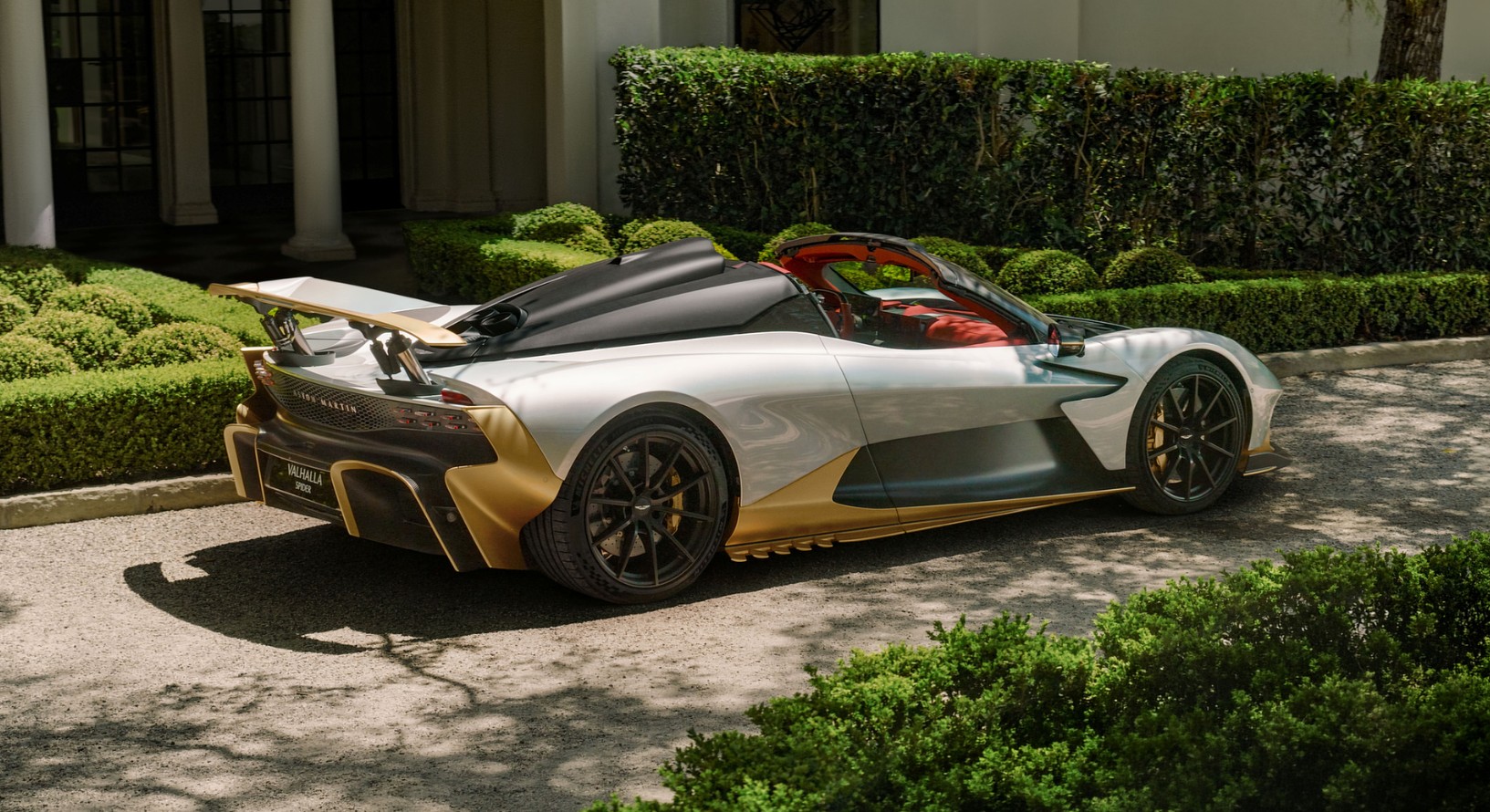
The exterior of the 2028 Aston Martin Valhalla Spider preserves the dramatic proportions of the Coupe while introducing the changes required for open-air driving. Its low nose, sculpted front bodywork, pronounced side channels, and compact cabin create an unmistakable mid-engine supercar silhouette. The absence of a fixed roof exposes more of the cockpit and changes the visual relationship between the windscreen, engine cover, and rear bodywork. Aston Martin has worked to retain the Valhalla’s clean design rather than adding bulky structural elements that would compromise its appearance. The result is a roadster that maintains the original car’s aggressive character while offering a more direct connection between the occupants, engine, and surrounding environment.
The roof system is one of the Spider’s defining features. A removable black fabric roof comes as standard and can be stored when the driver wants to enjoy open-air motoring. With this fabric roof installed, the maximum permitted speed is 124 mph, reflecting the aerodynamic limitations of that configuration. Buyers can also select an optional carbon-fiber hardtop, which allows the car to reach its full electronically limited 217-mph maximum speed with the roof fitted. When the roof is removed, the Spider can also achieve the full 217-mph figure. Aston Martin supplies a rain cover for stationary protection, giving owners a practical solution when the car is parked outdoors.
Air management required considerable attention because removing the roof changes the airflow around the cockpit and rear engine intake. Aston Martin has developed a dedicated wind deflector that clips into place when the fabric roof or hardtop is removed. Its purpose is to guide air over the occupants while maintaining the airflow required by the engine intake and cooling system. The rear snorkel has also been reshaped and raised by 35 millimeters compared with the Coupe. When not required, the wind deflector folds into three sections and can be stored inside newly integrated 15-liter sill compartments. These details show that the Spider’s redesign involves functional engineering rather than appearance alone.
The signature carbon-fiber dihedral doors remain part of the Valhalla Spider’s identity, preserving the theatrical entrance associated with the Coupe. Aston Martin has refined their operating geometry for smoother movement and introduced a frameless design. The upper edge of the door glass also has a slightly revised curvature to improve access when the roof is installed. The cabin receives a new carbon-fiber Touring Seat as standard, providing additional room around the hips and shoulders and making entry and exit more convenient. Buyers who prefer a more focused driving position can select the original Coupe carbon-fiber seat at no additional cost. This choice allows owners to prioritize either long-distance comfort or stronger lateral support during track driving.
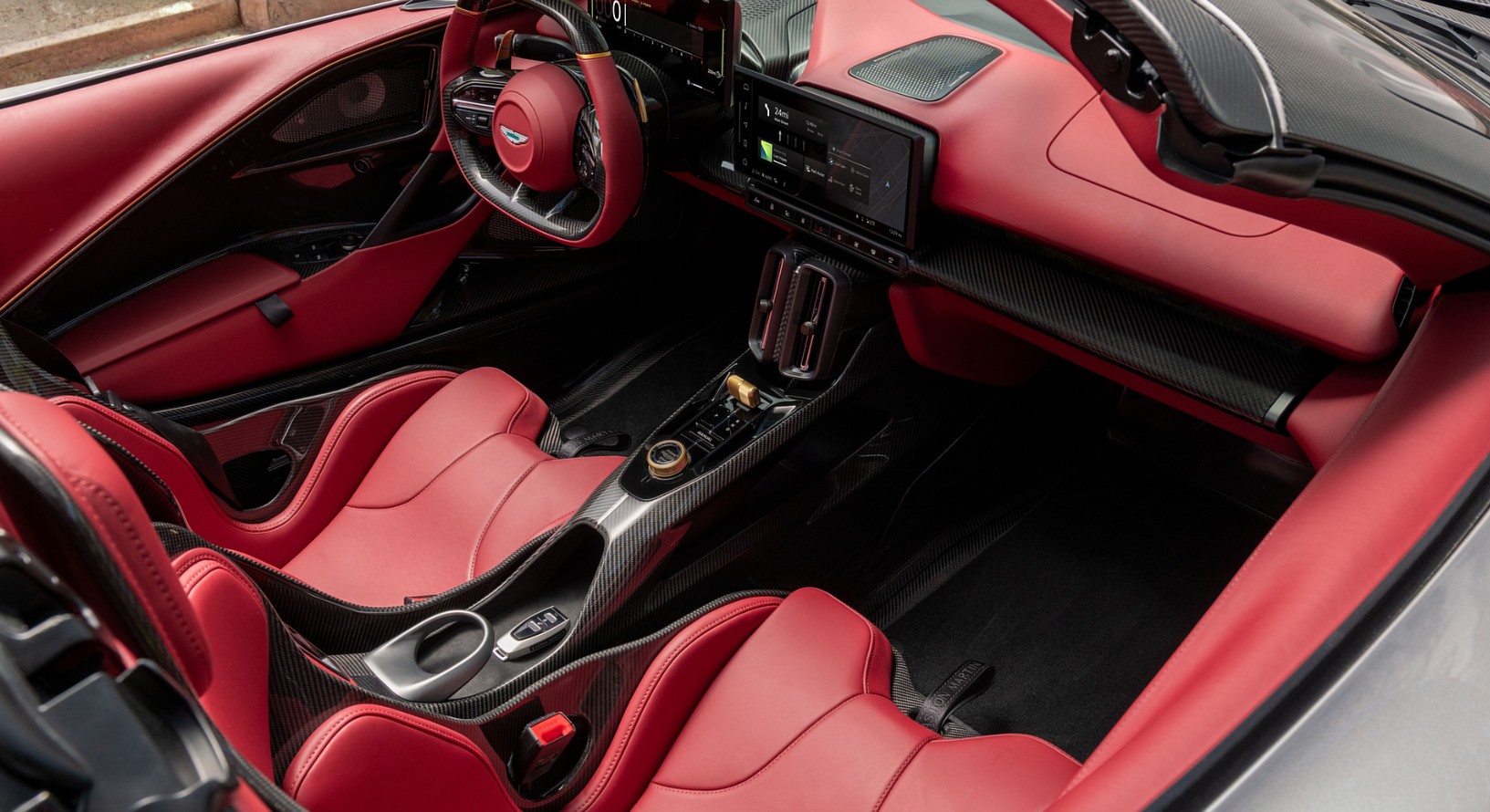
Inside, the Valhalla Spider follows the same driver-focused philosophy as the Coupe. The low seating position, cockpit layout, and close relationship between the driver and vehicle controls are designed around performance driving. A 10.25-inch digital driver display and a separate 10.25-inch central touchscreen provide the main information and infotainment interfaces. Wireless Apple CarPlay and connected-car functions support everyday use, while bespoke software provides access to vehicle settings and performance information. Carbon-fiber trim, Alcantara details, and carefully selected metallic finishes reinforce the car’s specialized character. Rather than turning the Spider into a luxury grand tourer with a large collection of comfort-focused features, Aston Martin keeps the cockpit centered on the driving experience.
2028 Aston Martin Valhalla Spider Specs
Engine & Performance
The powertrain is the most important part of the Valhalla Spider’s engineering package. At its center sits a bespoke 4.0-liter twin-turbocharged V8 with a flat-plane crankshaft, producing 828 PS. Aston Martin specifies a remarkable output of 207 bhp per liter, making it the highest-specific-output combustion engine fitted to one of the company’s production vehicles. The engine uses a dry-sump lubrication system designed to support high lateral forces during aggressive cornering, along with specialized charge cooling and turbocharger hardware. Its mid-mounted position helps establish the car’s weight distribution and creates the distinctive mechanical soundtrack that becomes even more prominent when the roof is removed.
The V8 works with three electric motors to produce a combined system output of 1,079 PS and 1,100 Nm of torque. Two electric motors are positioned on the front axle, forming an electric drive unit that provides torque vectoring and additional propulsion. The third electric motor is integrated into the rear transmission assembly, where it supports the V8 during acceleration and helps fill gaps in power delivery. The arrangement gives the Valhalla an advanced all-wheel-drive configuration without a conventional mechanical connection between the front and rear axles. Instead, electronic control manages how power reaches each wheel, allowing the car to respond rapidly to changing grip levels and driver inputs.
An eight-speed dual-clutch transmission transfers power to the rear wheels and incorporates an electronic differential and the integrated rear electric motor. The front electric drive unit can distribute torque between the front wheels to improve cornering response, stability, and traction. This arrangement is particularly important when accelerating out of tight corners, where the car needs to balance a substantial amount of power with available tire grip. The hybrid system also provides torque fill during gear changes and helps reduce the response delay normally associated with turbocharged engines. Aston Martin’s Integrated Vehicle Dynamics Control system coordinates the powertrain, suspension, steering, braking, and aerodynamic systems to create a consistent driving response.
Performance figures place the Valhalla Spider among the fastest open-top production cars in the world. Aston Martin claims acceleration from 0 to 62 mph in 2.5 seconds and an electronically limited top speed of 217 mph, or 350 km/h. The company specifically states that the maximum speed remains achievable with the roof removed, making the Spider the fastest open-cockpit Aston Martin produced to date. The car’s performance is supported by a 6.1-kWh high-voltage battery operating on a 400-volt electrical architecture. This battery supports the three-motor hybrid system and allows the car to operate in a pure electric driving mode under suitable conditions. An official electric-only driving range has not yet been published.
Aerodynamics and chassis engineering are just as important as engine output. The Valhalla Spider uses a bespoke carbon-fiber tub developed with Aston Martin Performance Technologies, providing a rigid passenger cell and a lightweight structural foundation. The suspension uses Formula 1-inspired pushrod architecture at the front, inboard adaptive dampers, and a multi-link rear arrangement. Active aerodynamic components at the front and rear adjust their positions to manage downforce and drag according to driving conditions. In Race mode, the Valhalla can generate more than 600 kilograms of downforce at 150 mph with the roof fitted. The Spider’s active aerodynamic and electronic stability systems have been recalibrated to account for the different airflow conditions created by its open cockpit.
The driver can select from four driving modes, allowing the vehicle’s character to change according to the road, circuit, and preferred level of performance. The Integrated Vehicle Dynamics Control system continuously monitors the car’s behavior and coordinates the relevant mechanical and electronic systems. Electric torque vectoring helps the front axle improve turn-in response, while the active rear wing and front aerodynamic elements manage high-speed balance. Carbon-ceramic brakes provide the stopping performance expected from a car capable of reaching 217 mph, and brake-by-wire technology forms part of the advanced braking architecture. The objective is not simply to deliver extreme acceleration but to make the car controllable and predictable when its performance is used on demanding roads and race circuits. 2028 Aston Martin Valhalla Spider Redesign
2028 Aston Martin Valhalla Spider Fuel Economy
Fuel economy is an area where official figures remain unavailable. Aston Martin’s Valhalla specification information states that WLTP emissions and consumption figures are undergoing homologation, with final results to be released after testing is completed. This means there is currently no confirmed official combined fuel-consumption rating or certified electric-only range that can be accurately quoted for the Spider. Its plug-in hybrid system uses a 6.1-kWh battery and can operate in Pure EV mode, but the battery’s capacity alone is not enough to establish a reliable driving-range estimate. The final figures will depend on the completed certification process and the specific market’s testing standards.
Real-world efficiency will also depend heavily on how the car is driven. A 1,079-PS hybrid supercar designed for extreme acceleration and high-speed circuit performance will have very different consumption characteristics from a conventional plug-in hybrid family vehicle. Frequent use of the V8, aggressive acceleration, high-speed driving, and repeated track sessions will naturally increase fuel consumption. Electric assistance can reduce engine use in selected situations and provide smooth low-speed operation, but it should not be confused with a promise of long-distance electric commuting. Owners should expect fuel efficiency to be a secondary consideration compared with performance, engineering, and driving enjoyment. The official consumption and emissions data should be checked once Aston Martin completes homologation.
2028 Aston Martin Valhalla Spider Safety Features
Safety engineering begins with the Valhalla Spider’s carbon-fiber passenger cell. The structure is based on the Coupe’s bespoke carbon tub, developed using resin-transfer molding and autoclave technology associated with high-performance motorsport construction. Its purpose is to provide a strong and rigid safety cell while keeping weight under control. The vehicle also incorporates driver and front-passenger airbags, seatbelt pretensioners, and seatbelt occupancy detection. These systems form the foundation of occupant protection, while the carbon-fiber architecture helps maintain structural integrity under demanding driving conditions. Although the Valhalla is primarily a high-performance supercar, its safety engineering is designed to support both road use and extreme performance driving.
The standard Valhalla specification also includes a range of advanced driver-assistance systems. Depending on market availability, equipment includes Automatic Emergency Braking, Forward Collision Warning, Adaptive Cruise Control with Stop and Go functionality, Lane Keep Assist, Lane Departure Warning, and Driver Attention Assist. Traffic Sign Recognition can provide additional information about road restrictions, while Auto High Beam Control and market-dependent Matrix LED lighting support visibility at night. These systems are especially useful when the car is being driven outside a circuit environment, where traffic conditions and road hazards can change quickly. The precise availability of individual features may differ between countries because of local regulations and market-specific equipment requirements.
Parking and low-speed maneuvering receive attention through a 3D Surround View System, a rear-view parking camera, and front and rear parking sensors. These features are valuable because the Valhalla’s low seating position, wide body, and mid-engine proportions can make it difficult to judge the surrounding space in tight environments. A digital rear-view display further supports visibility, while keyless entry, remote central locking, an alarm, and an immobilizer provide security functions. The Spider’s open cockpit makes it particularly important to use the supplied rain cover and appropriate vehicle protection when parked. As with any exotic supercar, careful operation and suitable storage remain essential parts of ownership.
The infotainment system combines a 10.25-inch central touchscreen with a fully digital 10.25-inch driver display. Wireless Apple CarPlay and connected-car functions support navigation, communication, and entertainment, while the digital instrument panel presents vehicle information in the driver’s direct line of sight. The interface is designed specifically for the Valhalla rather than simply adapting a conventional luxury-car system. Performance-related information and vehicle settings are integrated into the wider electronic architecture, allowing the driver to interact with the car’s hybrid and chassis systems. In an open-top vehicle, the sound of the V8 and the surrounding environment remain central to the experience, so the technology is intended to support driving rather than dominate the cabin.
2028 Aston Martin Valhalla Spider Release Date & Price
The 2028 Aston Martin Valhalla Spider is not expected to follow a conventional trim-level structure. Instead, it is a limited-production supercar offered in a single core mechanical configuration, with customers able to personalize the specification through roof choices, seat options, finishes, and bespoke exterior treatments. The standard configuration includes the removable black fabric roof and carbon-fiber Touring Seats. Buyers can choose the optional carbon-fiber hardtop if they want to retain the car’s full 217-mph top-speed capability with the roof installed. Those who prefer a more track-focused driving position can select the Coupe’s original carbon-fiber seats at no additional cost. This approach gives customers meaningful specification choices without creating multiple engine or performance versions.
Exterior personalization is expected to play an important role in the Spider’s exclusivity. HWM Aston Martin has reported that the car offers ten livery themes, with five available across either roof system and another five associated exclusively with the carbon-fiber hardtop. Exposed and tinted carbon-fiber finishes provide further opportunities to create an individual appearance. Customers may also work with Aston Martin’s Q personalization division to select bespoke colors, materials, and detailing, subject to availability and approval. Optional Brembo CCM-R Plus brake discs are available for owners who expect to use the car regularly on circuits and want braking components designed to tolerate sustained high temperatures. These options allow each example to reflect its owner’s priorities.
Pricing has not been officially announced by Aston Martin, so buyers should treat all published estimates as preliminary. Top Gear reported an expected starting price of approximately £1.3 million or more for the Valhalla Spider, suggesting a premium over the fixed-roof Coupe. Car and Driver has also noted that the Spider should cost more than the Coupe’s reported U.S. starting price of approximately $1,051,700. The final transaction price will depend on market taxes, specification, optional equipment, personalization, and dealer arrangements. With production restricted to a small number of vehicles, the cost of individual examples could rise considerably when customers add extensive carbon-fiber finishes, bespoke paint, special interior materials, or track-oriented equipment.
The production and release schedule is more clearly defined than the final pricing. Aston Martin officially unveiled the Valhalla Spider on October 28, 2026, and confirmed that customer deliveries will begin in the third quarter of 2027. HWM Aston Martin has reported that production of the 2028 model-year Spider is scheduled to begin in May 2027, with delivery timing to be confirmed by the retailer. The vehicle’s global debut is scheduled for the 2026 Concours at Wynn Las Vegas. Although the car carries a 2028 model-year designation in dealer information and automotive coverage, the first customer deliveries are expected during 2027. Buyers should therefore distinguish the model-year label from the actual production and delivery calendar.
The 2028 Aston Martin Valhalla Spider represents a significant expansion of the Valhalla lineup, bringing open-air driving to a platform already defined by advanced hybrid engineering and Formula 1-inspired technology. Its 1,079 PS powertrain, three electric motors, 217-mph maximum speed, carbon-fiber structure, and active aerodynamics give it the performance credentials expected from an elite supercar. The Spider adds a removable roof system, revised airflow management, dedicated Touring Seats, and additional storage without abandoning the Coupe’s core engineering. Its limited production makes it particularly exclusive, while its combination of combustion power and electric assistance reflects the direction of modern high-performance automotive development. 2028 Aston Martin Valhalla Spider Redesign
Conclusion
For collectors and drivers seeking something beyond a conventional convertible, the Valhalla Spider offers a distinctive combination of rarity, technology, and mechanical character. Its open cockpit makes the flat-plane V8 more immediate, while electric torque vectoring and active aerodynamics help preserve the stability needed for serious performance. The optional hardtop provides another level of flexibility, and the extensive personalization program allows owners to create highly individual examples. The final price and certified efficiency figures remain outstanding details, but the core specifications and release schedule are already established. With production limited and deliveries planned from the third quarter of 2027, the 2028 Aston Martin Valhalla Spider is set to become one of the most exclusive open-top hybrid supercars of its generation.
Note: The details included in this blog post are derived from pre-release material that was accessible when the article was written. If you want the latest information, you should check official sources or call your nearest dealership.
Frequently Asked Questions
2028 Aston Martin Valhalla Spider Redesign, Specs, Price - The 2028 Aston Martin Valhalla Spider brings a new dimension to one of the most ambitious supercars in the British manufacturer's history. Officially unveiled on October 28, 2026, the Spider transforms the mid-engine Valhalla into an open-cockpit performance machine…
The Spider is more than a conventional convertible version of the Valhalla Coupe. Aston Martin has reworked the vehicle's aerodynamic management, airflow systems, electronic stability calibration, and roof arrangements to preserve its high-speed behavior. The result is a car designed to deliver two distinct experiences: the precision and…
The Valhalla Spider also represents an important milestone for Aston Martin because it is the company's first series-production mid-engine open-cockpit supercar. Its development builds on the Valhalla Coupe's carbon-fiber architecture and plug-in hybrid technology, with engineering support from Aston Martin Performance Technologies, the technical consulting arm associated with…
Exclusivity will be another major part of the Valhalla Spider's appeal. The entire Valhalla production program is limited to 999 vehicles, with the Spider expected to account for approximately one-quarter of that total. Aston Martin dealer information identifies a planned allocation of 249 Spider examples worldwide, although the…
2028 Aston Martin Valhalla Spider Redesign and Update Plan Exterior & Interior The exterior of the 2028 Aston Martin Valhalla Spider preserves the dramatic proportions of the Coupe while introducing the changes required for open-air driving. Its low nose, sculpted front bodywork, pronounced side channels, and compact cabin…