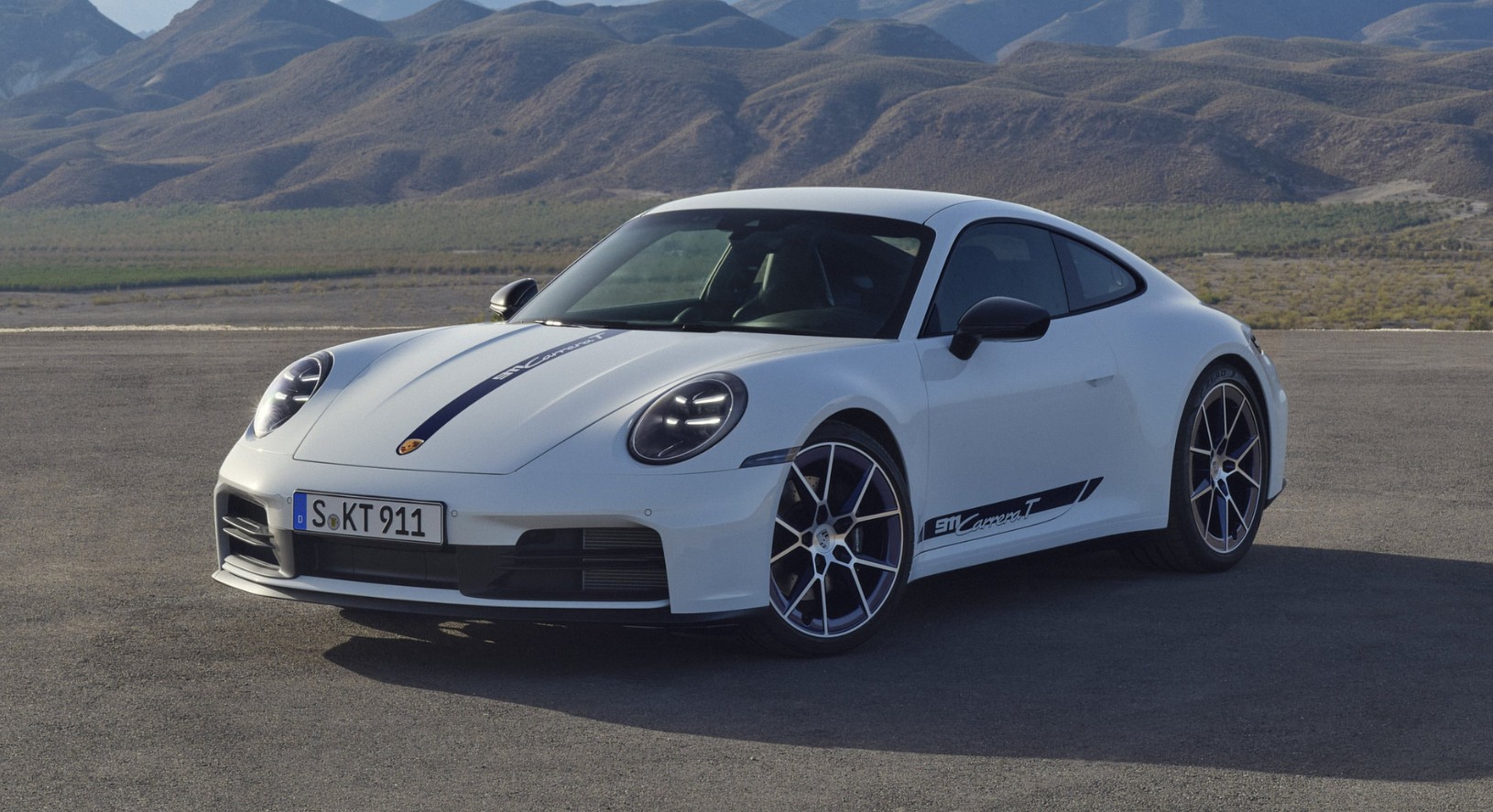
2028 Porsche 911 Carrera T Redesign, Specs, Performance – The 2028 Porsche 911 Carrera T could become one of the most interesting enthusiast-focused versions of the next-generation 911 lineup. Porsche has not yet officially announced a 2028 Carrera T, so the specifications, equipment, pricing, and launch timing discussed here should be treated as informed expectations rather than confirmed factory data. The current 2027 Porsche 911 Carrera T provides a strong foundation for understanding what could come next. It combines a rear-wheel-drive layout, a manual transmission, a twin-turbocharged flat-six, lightweight construction, rear-axle steering, and a chassis specifically tuned around driver involvement. Porsche currently lists the 2027 Carrera T with 388 hp, a 4.3-second 0–60 mph time, and an $148,000 starting MSRP in the United States.
For 2028, the Carrera T is unlikely to need a radical visual transformation because Porsche’s strategy with the T designation has traditionally been about carefully refining an existing Carrera rather than turning it into a completely different car. The current generation already demonstrates that philosophy: Porsche removed weight, reduced insulation, added rear-axle steering, gave the suspension a more focused setup, and paired the car exclusively with a manual gearbox. The 2025 Carrera T was also introduced as both a Coupé and, for the first time, a Cabriolet, expanding the concept beyond the traditional fixed-roof configuration. The lightest current configuration can weigh as little as 1,478 kilograms with full bucket seats, showing how seriously Porsche treats the lightweight side of the Carrera T formula.
A potential 2028 update could therefore concentrate on calibration rather than headline-grabbing horsepower. Porsche may refine suspension tuning, steering response, aerodynamic details, infotainment software, cabin materials, and driver-assistance technology while protecting the characteristics that separate the Carrera T from a conventional Carrera. The manual gearbox will be especially important. Porsche has continued expanding manual availability within the 911 family, including the 2027 Carrera S with a six-speed manual in North America, while explicitly describing the Carrera T as an enthusiast-focused model built around three pedals and driver engagement. That broader strategy suggests that the Carrera T’s identity remains relevant even as other 911 variants adopt increasingly sophisticated powertrain technology.
The most important point is that Porsche has not published an official 2028 Carrera T specification sheet at the time of writing. Consequently, claims about an exact engine output, curb weight, fuel economy figure, MSRP, or release date would be premature. The 2027 model is the latest confirmed reference point, and it gives us a realistic picture of the direction Porsche could take. Rather than turning the 2028 Carrera T into an extreme track car, the more logical development would be a sharper road-going sports car that remains usable every day. That balance is precisely what has made the Carrera T formula distinctive: it offers more chassis involvement than a standard Carrera without requiring buyers to step all the way into the GT3 world. 2028 Porsche 911 Carrera T Redesign
2028 Porsche 911 Carrera T Redesign and Update Plan
Exterior & Interior
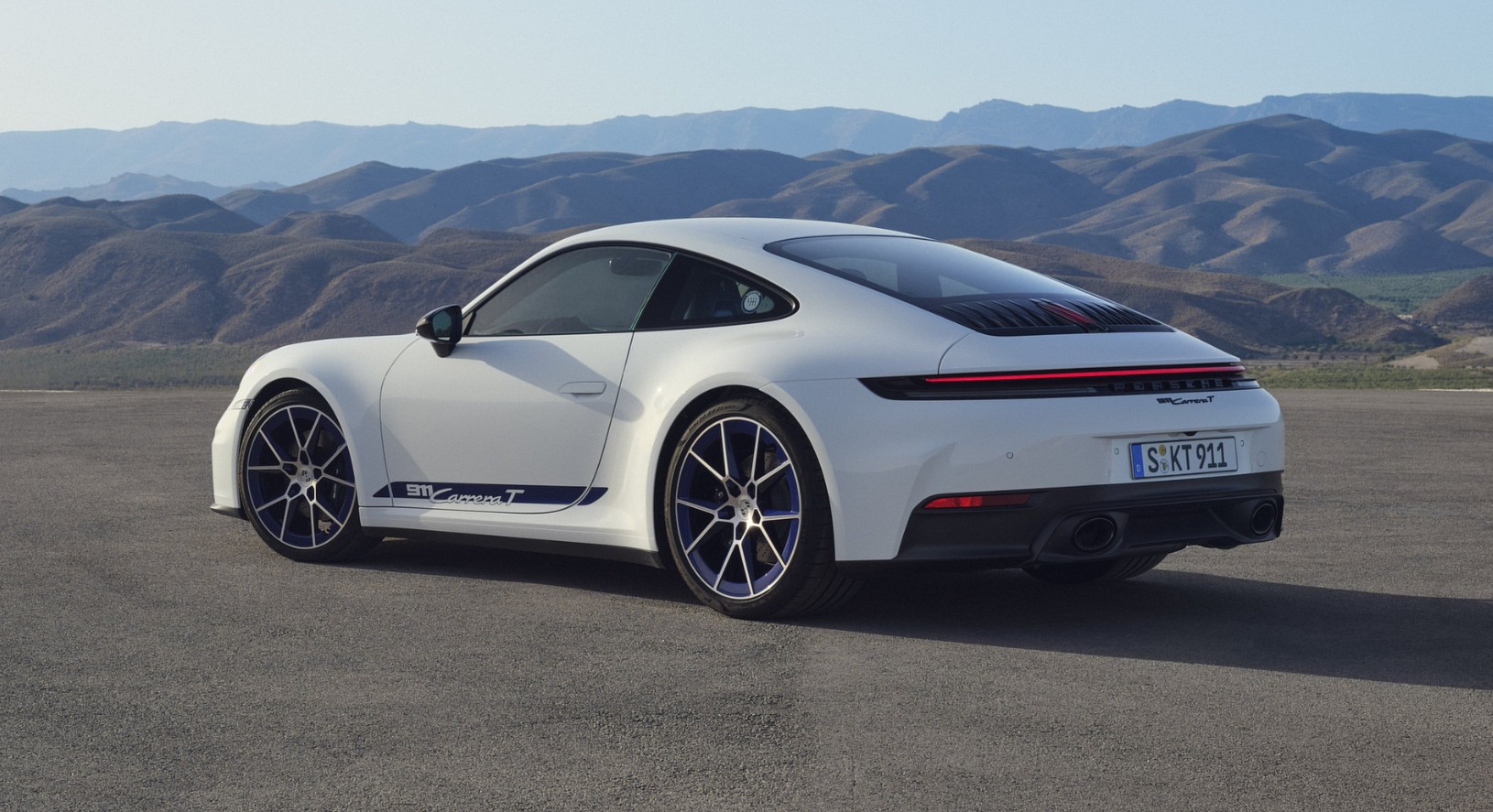
The exterior of the 2028 Porsche 911 Carrera T should retain the unmistakable 911 silhouette, including the low nose, wide rear haunches, sloping roofline, and compact greenhouse that have defined the model for decades. The Carrera T’s visual identity is normally more restrained than that of a GT3 or GT3 RS. Instead of enormous aerodynamic appendages, Porsche uses subtle details to communicate the car’s purpose. The current Carrera T incorporates distinctive exterior finishes and equipment associated with its lightweight, driver-focused character, while its chassis hardware does much more of the talking than the bodywork. A future 2028 model could receive revised lighting signatures, updated bumper detailing, new wheel finishes, and additional color choices without losing the understated appearance that suits the T badge.
Wheels will remain a critical part of the visual package because the Carrera T is as much about chassis balance as outright engine power. The current generation uses large staggered wheels and performance-oriented tires, with Porsche’s technical documentation showing 20-inch front and 21-inch rear wheels on the Carrera T formula. Rear-axle steering is also standard, giving the car a mechanical and electronic chassis advantage without visually changing the classic 911 profile. For 2028, Porsche could introduce a new wheel design with further weight optimization or offer additional finishes through Porsche Exclusive Manufaktur. The emphasis would likely remain on reducing unsprung mass and maintaining responsive steering rather than simply increasing wheel diameter.
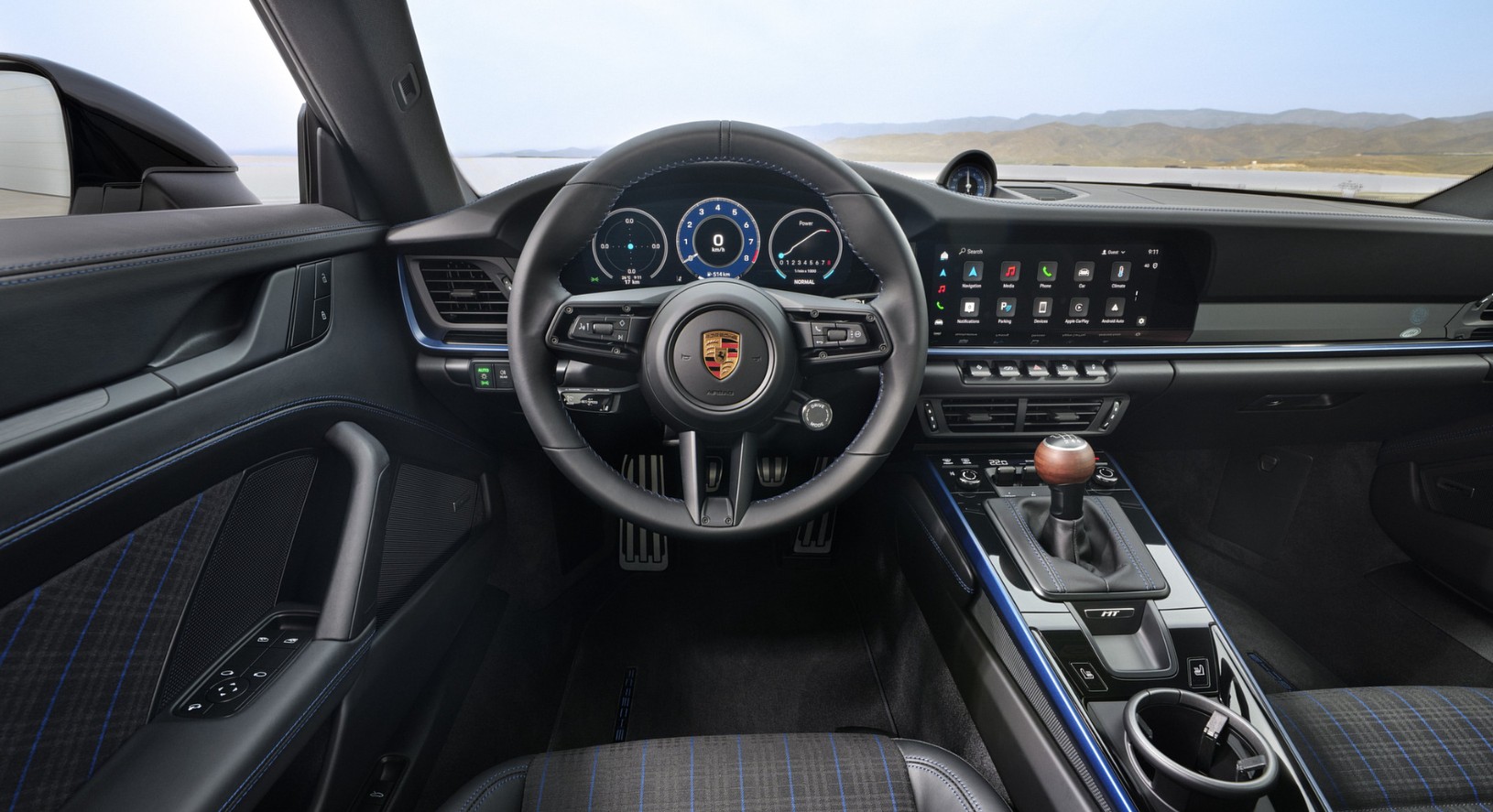
Inside, the 2028 Carrera T should continue to separate itself from the ordinary Carrera through a more focused atmosphere rather than abandoning luxury. The current Carrera T uses lightweight construction measures, reduced sound insulation, sport-oriented seating, and a distinctive open-pore laminated walnut shift knob. That combination is unusual in a modern luxury sports car because it deliberately allows more mechanical sound and road texture into the cabin. Porsche has also retained modern connectivity and infotainment technology throughout the latest 911 generation, meaning a future Carrera T does not need to sacrifice digital convenience simply because it prioritizes analog driving. A 2028 interior could bring updated displays, software, connectivity, and materials while keeping the manual shifter as the centerpiece.
The seating strategy should remain particularly interesting. Porsche could continue offering lightweight bucket seats for customers who want the lowest possible mass and stronger lateral support, while standard sport seats would preserve everyday comfort for longer road trips. The current Carrera T can be configured with full bucket seats, and Porsche has demonstrated that the model can shed meaningful weight through lightweight windows and reduced insulation. For 2028, further lightweight options could include thinner glass, lighter seats, selective use of composite materials, and additional weight-conscious equipment choices. At the same time, the cabin should retain the premium finish expected from a Porsche 911, creating a useful combination of motorsport-inspired simplicity and high-end craftsmanship rather than an austere stripped-out interior.
2028 Porsche 911 Carrera T Specs
Engine & Performance
The powertrain will probably remain the defining element of the 2028 Porsche 911 Carrera T. The current 2027 Carrera T uses a 3.0-liter twin-turbocharged six-cylinder boxer engine producing 388 hp in the United States, paired with a manual transmission and rear-wheel drive. Porsche’s current international specification lists 290 kW, or 394 PS, and a 4.5-second 0–100 km/h time, while the U.S. specification quotes 388 hp and 4.3 seconds from 0–60 mph. The difference between these published figures comes from market-specific measurement conventions and test methodology rather than indicating two fundamentally different engines.
For 2028, an increase in output is possible, but it should not be assumed until Porsche officially confirms the model. The current Carrera produces the same 388-hp figure in the U.S. market, while the Carrera S has moved significantly higher to 473 hp. That leaves the Carrera T occupying an unusual position: it does not rely on a huge power advantage over the standard Carrera. Instead, it creates its personality through transmission choice, weight reduction, suspension tuning, rear-axle steering, and a more immersive driving environment. That formula makes sense because excessive power could actually move the Carrera T away from its original purpose. The appeal is not simply acceleration; it is the interaction between driver, engine, clutch, gearbox, steering, brakes, and rear tires.
The six-speed manual transmission should remain the most important hardware feature if Porsche carries the Carrera T philosophy into 2028. The current Carrera T is offered with a manual gearbox, and Porsche specifically describes the model as concentrating on puristic driving pleasure, lightweight construction, agility, and an emotional soundscape. Rear-axle steering is standard, while the suspension receives Carrera T-specific tuning. These characteristics create a car that can feel more communicative at ordinary road speeds than a much more powerful model. A future Carrera T could improve shift quality, clutch calibration, throttle response, and rev-matching behavior while preserving the physical connection that makes three-pedal driving attractive to enthusiasts.
Performance should remain more than adequate even without a dramatic horsepower increase. The current U.S.-market 2027 Carrera T reaches 60 mph in 4.3 seconds and has a listed top track speed of 183 mph with summer tires. Porsche’s international specification gives the current car a 295 km/h top speed. Those numbers already place the Carrera T comfortably within serious sports-car territory. For 2028, Porsche could improve acceleration through small gains in power, traction management, gearing, or weight reduction, but the greater opportunity may be in cornering response and braking consistency. The Carrera T does not need to chase the acceleration numbers of a Turbo or GT3 to justify its existence; its strongest performance characteristic is the quality of the driver’s interaction with the car. 2028 Porsche 911 Carrera T Redesign
2028 Porsche 911 Carrera T Fuel Economy
Fuel economy is another area where expectations need to remain realistic. The current international Porsche specification lists the 2027 Carrera T at approximately 10.9–10.4 liters per 100 kilometers combined under the applicable WLTP testing range, with CO₂ emissions of approximately 248–237 g/km. Those figures demonstrate that the Carrera T is relatively efficient for a high-performance twin-turbocharged six-cylinder sports car, but it is not designed as an economy vehicle. Real-world consumption will vary significantly with traffic, driving style, temperature, tire choice, road conditions, and how frequently the engine is used at high load.
A 2028 update could improve efficiency through engine-management calibration, lower-friction components, revised gearing, aerodynamic optimization, and tire technology. Porsche could also use more efficient ancillary systems without changing the basic combustion-engine character. Nevertheless, a dramatic fuel-economy improvement should not be expected unless Porsche makes a major powertrain change. The Carrera T’s appeal comes from its 3.0-liter turbocharged boxer engine and manual rear-wheel-drive configuration, so efficiency improvements are more likely to be incremental. For daily driving, the bigger advantage may be the car’s combination of compact dimensions, usable luggage areas, comfortable highway manners, and sophisticated chassis technology, allowing it to serve as both a weekend sports car and a genuine road-trip machine.
2028 Porsche 911 Carrera T Safety Features
Safety equipment will remain an important part of the 2028 Carrera T story, particularly because the model is still intended to function as a road car rather than a dedicated circuit machine. The current 911 family incorporates a broad range of electronic safety and assistance systems, although equipment can vary by market and configuration. Available technologies across the current 911 range include ParkAssist, reversing-camera functionality, Lane Change Assist, Adaptive Cruise Control with Porsche Active Safe, and other driver-support technologies. Porsche also uses Porsche Stability Management and advanced braking systems as part of the 911’s dynamic safety architecture.
For a future 2028 Carrera T, the challenge will be balancing additional technology against the lightweight philosophy. More sensors, cameras, displays, and electronic systems can improve convenience and collision avoidance, but they can also add weight and complexity. Porsche therefore has an incentive to make optional equipment available without forcing every enthusiast to carry unnecessary hardware. A likely configuration could include advanced LED or Matrix LED lighting, parking assistance, lane-related monitoring, emergency braking assistance, traffic-sign recognition, and improved camera systems, while keeping more sophisticated features optional depending on the market. The exact 2028 standard-equipment list remains unconfirmed, so current 911 equipment should be treated as the reference point rather than a guaranteed specification.
2028 Porsche 911 Carrera T Release Date & Price
The 2028 Porsche 911 Carrera T could remain a relatively straightforward model within the broader 911 family. Porsche’s current lineup positions the Carrera T between the regular Carrera and more powerful variants such as the Carrera S, while the T itself is offered as a rear-wheel-drive manual model. For 2027, Porsche lists the Carrera at $135,500 in the United States and the Carrera T at $148,000, while the Carrera S begins at $156,200. The Carrera T therefore occupies a distinct middle position based on price while offering a completely different transmission and chassis philosophy.
The Carrera T Cabriolet should also remain an important possibility for 2028. Porsche introduced the Carrera T Cabriolet for the first time with the 2025 generation, and the current 2027 U.S. model is listed from $161,900, with 388 hp, rear-wheel drive, a manual transmission, and a 4.5-second 0–60 mph time. That makes the Cabriolet more expensive and slightly slower than the Coupé because of its additional structure and weight, but it provides a very different driving experience.
Pricing for the 2028 Porsche 911 Carrera T has not been announced. If Porsche carries the current formula forward, a modest increase over the 2027 U.S. starting price would be plausible, but an exact figure should not be presented as official. The 2027 Carrera T currently starts at $148,000 before options, taxes, registration, delivery, processing and handling charges, while the Carrera T Cabriolet starts at $161,900. Porsche’s extensive options catalog can also raise the final transaction price considerably, particularly when buyers add premium wheels, specialty paint, carbon or lightweight equipment, upgraded seats, advanced lighting, interior customization, and other Porsche Exclusive Manufaktur selections.
The official 2028 release date is also unknown because Porsche has not announced the model. A reasonable expectation is that any 2028 Carrera T would be revealed and opened for ordering during the 2027 calendar year if Porsche follows a conventional model-year cycle, with customer deliveries potentially beginning later in 2027 or during 2028 depending on market. That timing is an expectation, not a confirmed Porsche schedule. What is already clear is that Porsche continues to treat the Carrera T as an important manual-transmission member of the 911 family. With the 2027 Carrera T already confirmed and the manual Carrera S returning to North America, the conditions exist for the T formula to continue into a future model year, but the final 2028 specification will require an official Porsche announcement. 2028 Porsche 911 Carrera T Redesign
Conclusion
The 2028 Porsche 911 Carrera T has the potential to remain one of the most distinctive 911 variants because its appeal does not depend on chasing the biggest horsepower number. The current formula is built around a 3.0-liter twin-turbo flat-six, rear-wheel drive, a manual gearbox, lightweight construction, rear-axle steering, focused suspension tuning, and an interior designed to keep the driver connected to the mechanical character of the car.
At present, Porsche has not officially confirmed the 2028 Carrera T, so its final engine output, weight, equipment, fuel economy, pricing, and release date remain unknown. The confirmed 2027 Carrera T nevertheless provides a clear benchmark, with 388 hp, a 4.3-second U.S. 0–60 mph time, an 183-mph top track speed, and a $148,000 starting MSRP.
If Porsche preserves the philosophy that has defined the Carrera T, the 2028 model should not need extreme styling or enormous power to stand out. Its strongest selling point would remain the same fundamental idea: a modern Porsche 911 that uses contemporary engineering to make traditional driver involvement feel relevant in a rapidly changing sports-car market. For enthusiasts who value a manual transmission, lightweight construction, responsive chassis tuning, and the unmistakable character of a flat-six 911, that combination remains highly significant.
Note: The details included in this blog post are derived from pre-release material that was accessible when the article was written. If you want the latest information, you should check official sources or call your nearest dealership.
Read Also:
- 2028 Porsche Taycan Black Edition Review, Specs, Interior
- 2027 Porsche Cayenne Turbo E-Hybrid Coupe Price, Specs, Interior
- 2027 Porsche Taycan Release Date, Specs, Price
- 2027 Porsche Cayenne Review, Specs, Features
- 2027 Porsche Cayenne E-Hybrid Release Date, Dimensions, Specs
Frequently Asked Questions
2028 Porsche 911 Carrera T Redesign, Specs, Performance - The 2028 Porsche 911 Carrera T could become one of the most interesting enthusiast-focused versions of the next-generation 911 lineup. Porsche has not yet officially announced a 2028 Carrera T, so the specifications, equipment, pricing, and launch timing discussed…
For 2028, the Carrera T is unlikely to need a radical visual transformation because Porsche's strategy with the T designation has traditionally been about carefully refining an existing Carrera rather than turning it into a completely different car. The current generation already demonstrates that philosophy: Porsche removed weight,…
A potential 2028 update could therefore concentrate on calibration rather than headline-grabbing horsepower. Porsche may refine suspension tuning, steering response, aerodynamic details, infotainment software, cabin materials, and driver-assistance technology while protecting the characteristics that separate the Carrera T from a conventional Carrera. The manual gearbox will be especially…
The most important point is that Porsche has not published an official 2028 Carrera T specification sheet at the time of writing. Consequently, claims about an exact engine output, curb weight, fuel economy figure, MSRP, or release date would be premature. The 2027 model is the latest confirmed…
2028 Porsche 911 Carrera T Redesign and Update Plan Exterior & Interior The exterior of the 2028 Porsche 911 Carrera T should retain the unmistakable 911 silhouette, including the low nose, wide rear haunches, sloping roofline, and compact greenhouse that have defined the model for decades. The Carrera…